Run and benchmark vLLM mixture of experts models on Arm CPUs
Introduction
Set up vLLM for MoE inference
Understand MoE models and precision choices
Run MoE inference with vLLM
Benchmark MoE serving performance
Review benchmark results
Next Steps
Run and benchmark vLLM mixture of experts models on Arm CPUs
Interpret the reported results
The ShareGPT ~512 input-token benchmarks focus on serving performance only. They compare the following metrics across BF16 and INT8/W8A8 runs:
- Request throughput
- Output token throughput
- Time to first token (TTFT)
- Time per output token (TPOT)
Model quality and accuracy weren’t evaluated in this benchmark pass.
The benchmark requested 512 output tokens and used vllm bench serve.
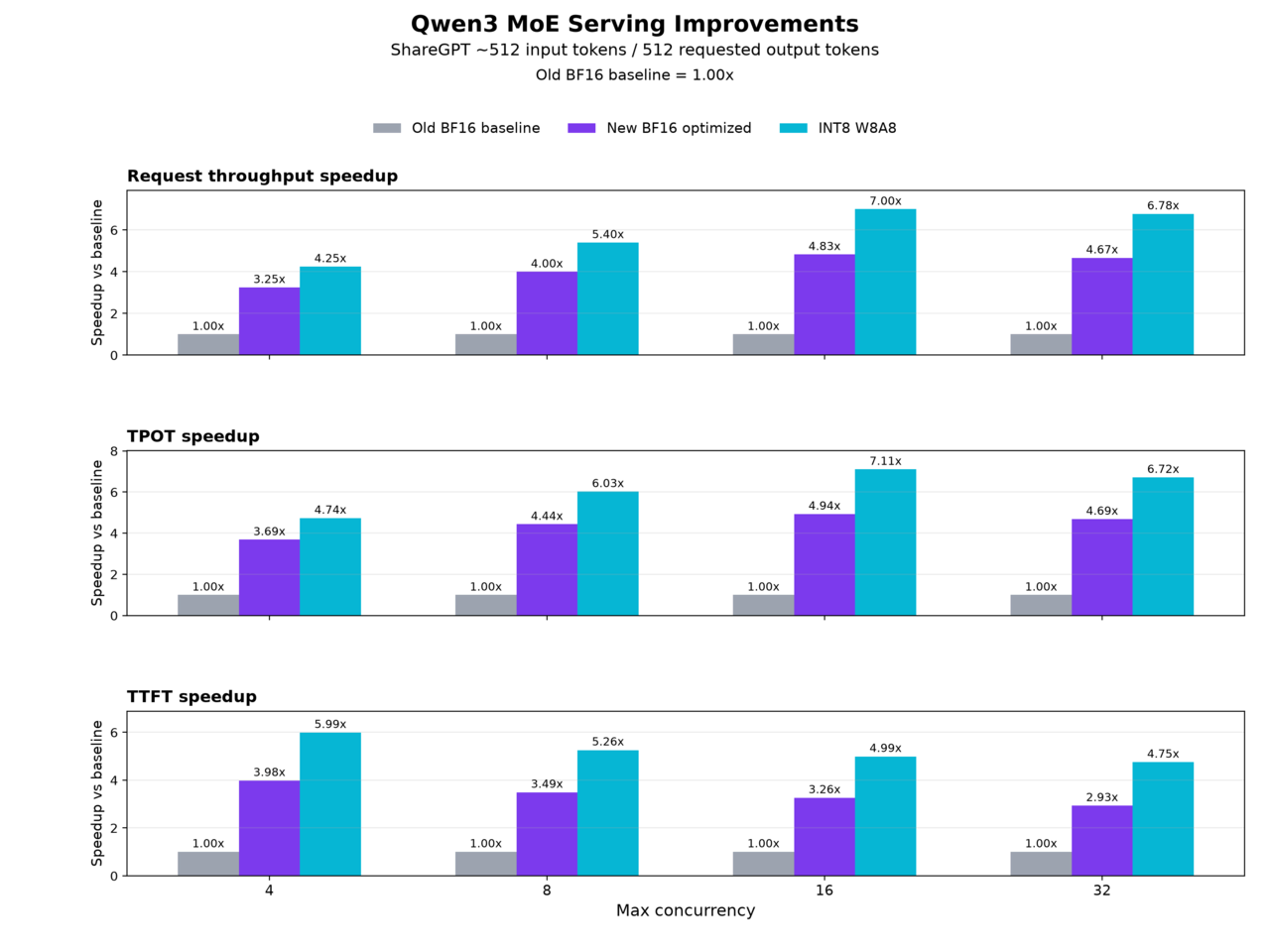
Throughput speedup is optimized throughput divided by baseline throughput. A 3.25x speedup means a 225% increase. Latency reduction is (baseline latency - optimized latency) / baseline latency × 100%. In the Qwen3 plot, latency speedup instead means baseline latency divided by optimized latency. Compare matching concurrency values and workloads.
Your measurements can vary with hardware, package versions, server settings, and system load.
Gemma 4 BF16 MoE
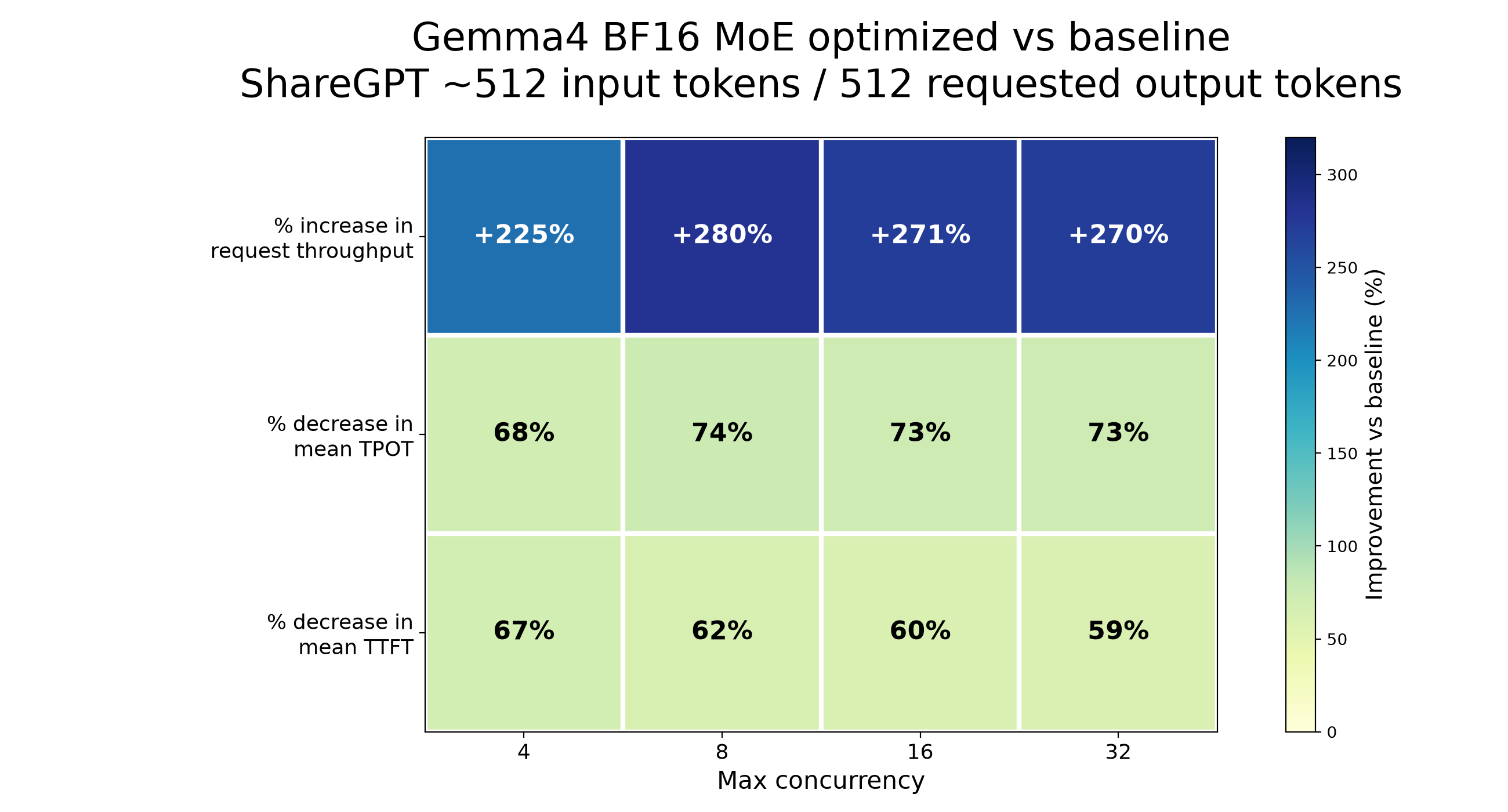
Gemma 4 was benchmarked with ShareGPT ~512 input-token prompt subsets.
The reported optimized BF16 mixture of experts (MoE) runs improve Gemma 4 request throughput by around 3.25x to 3.80x, depending on concurrency.
| Prompt subset | Requests per second speedup | Output tokens per second speedup | Mean TPOT reduction |
|---|---|---|---|
| ShareGPT ~512 input tokens | 3.25x - 3.80x | 3.15x - 3.83x | 68% - 74% |
These ratios describe the reported configuration and aren’t a performance guarantee for other Arm servers.
GPT-OSS BF16 MoE
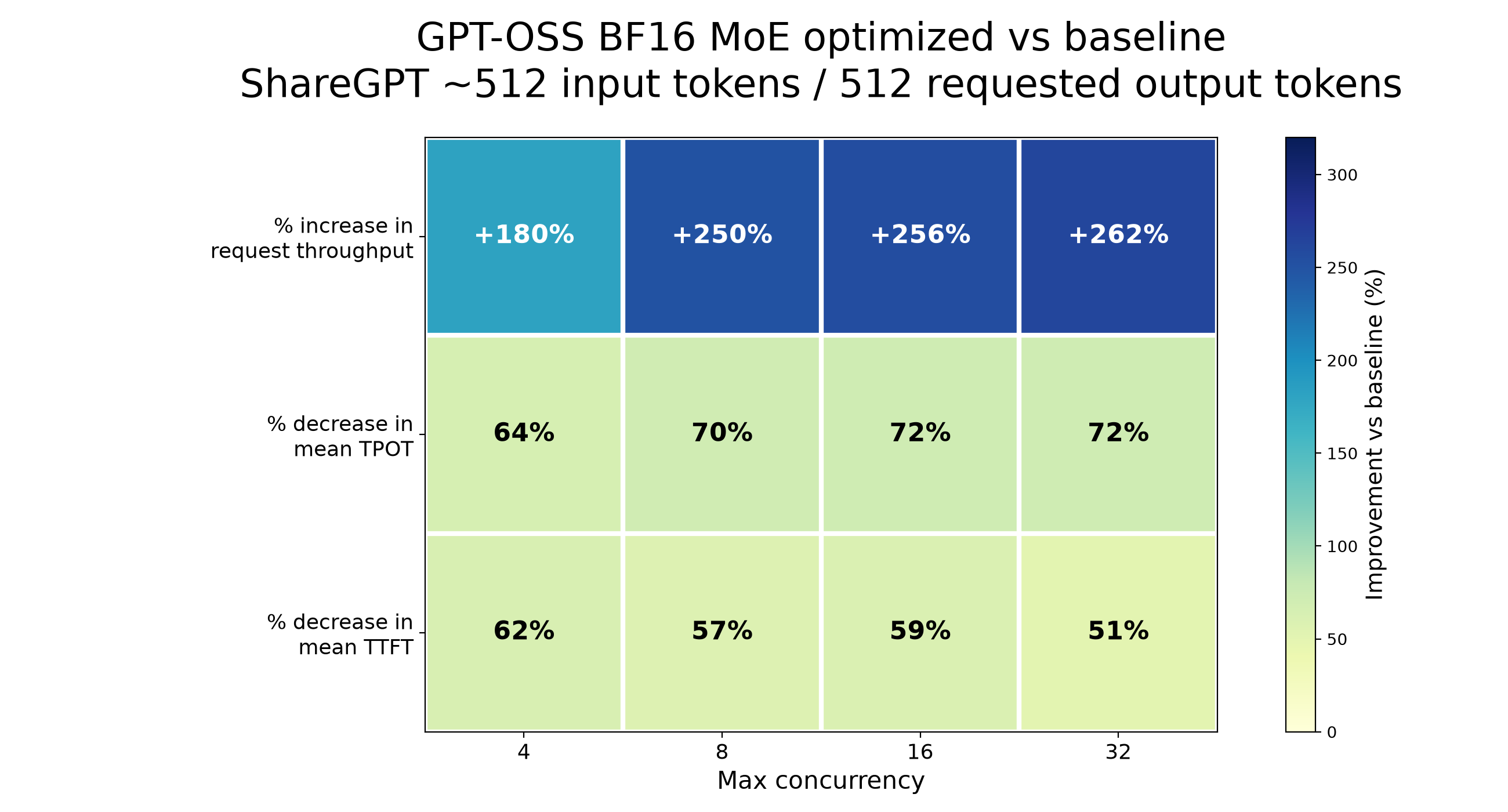
GPT-OSS was benchmarked with ShareGPT ~512 input-token prompt subsets.
The reported optimized BF16 MoE runs improve GPT-OSS request throughput by around 2.80x to 3.62x, depending on concurrency.
| Prompt subset | Requests per second speedup | Output tokens per second speedup | Mean TPOT reduction |
|---|---|---|---|
| ShareGPT ~512 input tokens | 2.80x - 3.62x | 2.74x - 3.50x | 64% - 72% |
Qwen3 BF16 and INT8/W8A8 MoE
The Qwen3 comparison uses pre-optimization BF16 as the baseline.
The comparison includes the pre-optimization Qwen BF16 baseline, new optimized Qwen BF16, and new Qwen INT8/W8A8.
The following ratios compare request throughput:
| Prompt subset | New BF16 versus pre-optimization BF16 | INT8/W8A8 versus pre-optimization BF16 | INT8/W8A8 versus new BF16 |
|---|---|---|---|
| ShareGPT ~512 input tokens | 3.25x - 4.83x | 4.25x - 7.00x | 1.31x - 1.45x |
Mean TPOT is also lower with INT8/W8A8 than with optimized BF16.
The reported measurements indicate two improvements:
- BF16 MoE optimization improves regular BF16 MoE models.
- INT8/W8A8 MoE support provides an additional optimized path compared with BF16.
What you’ve accomplished
You’ve now reviewed the benchmark results for BF16 and INT8/W8A8 MoE inference with vLLM on Arm CPUs.
Use the same workload, package versions, server settings, and concurrency values when comparing your results.