Profile ONNX model performance with SME2 using KleidiAI and ONNX Runtime
Introduction
ONNX Runtime architecture with SME2 acceleration
Integration of KleidiAI to ORT MLAS
Build ONNX Runtime with KleidiAI and SME2 for Android
Profile ONNX model performance
Next Steps
Profile ONNX model performance with SME2 using KleidiAI and ONNX Runtime
Integrating KleidiAI micro-kernels into ONNX Runtime
With the rise of on-device AI, squeezing performance from CPUs has become critical. Arm’s Scalable Matrix Extension 2 (SME2) represents a leap forward, offering significant speedups for matrix-heavy workloads like Transformers and CNNs.
This Learning Path walks you through the technical steps to integrate KleidiAI-Arm’s specialized micro-kernel library with SME2 support-into ONNX Runtime (ORT) and profile its performance using onnxruntime_perf_test on Android devices.
How does ONNX Runtime process AI models?
ONNX Runtime’s internal architecture consists of four main components that work together to execute AI models efficiently:
- In-Memory Graph: represents the model structure as nodes (operations) and edges (data flows)
- Graph Partitioner: assigns operations to appropriate hardware accelerators
- Graph Runner: orchestrates execution and manages data flow between operations
- Execution Provider: hardware-specific backends that run the actual computations
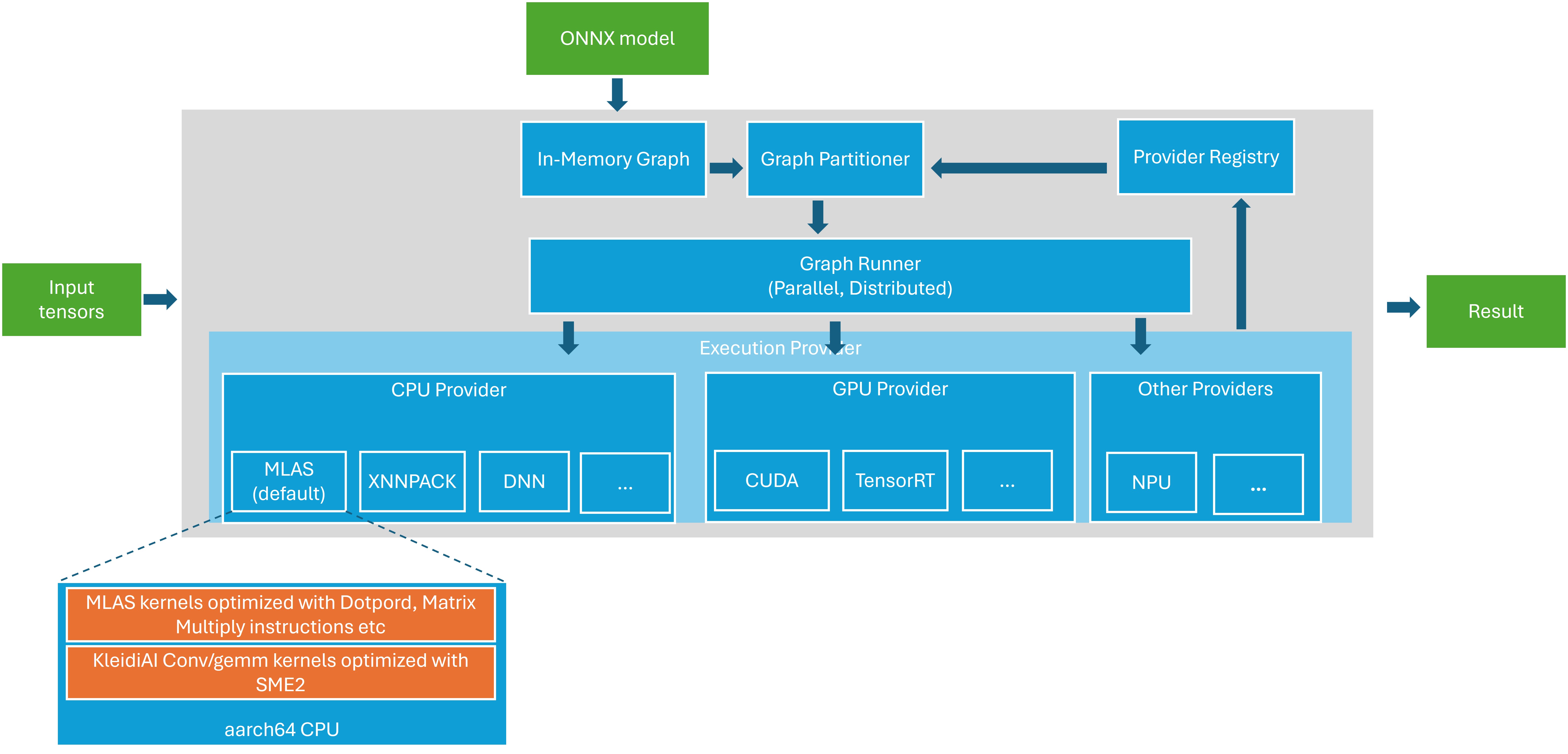 The ONNX Runtime overview
How does ONNX Runtime represent models in memory?
When ORT loads an ONNX model, it parses the protobuf file and builds an in-memory representation of the model’s structure. This graph consists of:
- Nodes: operations like MatMul, Conv, and Add
- Edges: tensor data flowing between operations
During this stage, ORT performs Graph Optimizations like constant folding and node fusion.
How does ONNX Runtime assign operations to hardware?
The Graph Partitioner decides which part of the model runs on which hardware. It analyzes the computational graph and matches nodes to the registered Execution Providers. It clusters adjacent nodes assigned to the same EP into “Subgraphs”.
How does ONNX Runtime execute operations?
Once the graph is partitioned, the Graph Runner executes the operators in the correct order. It manages the flow of data (Tensors) between nodes. In ORT, parallelism splits into two distinct levels to maximize hardware utilization: Intra-op (inside an operator/node, splitting a single heavy operation/node into smaller chunks) and Inter-op (between different operators, running multiple independent operators at the same time).
What are ONNX Runtime execution providers?
An Execution Provider is the abstraction layer that interfaces with specific hardware or libraries. Each EP provides optimized math functions (called “Kernels”) for specific operators.
ORT supports multiple Execution Providers across different hardware types:
CPU-based providers:
- Default CPU provider
- Intel DNNL
- XNNPACK
GPU-based providers:
- NVIDIA CUDA/TensorRT
- AMD MIGraphX
- DirectML
Specialized accelerators:
- NPU
- Qualcomm QNN
If a specialized EP doesn’t support a specific operator, ORT automatically falls back to the CPU provider.
The default CPU provider uses Microsoft Linear Algebra Subprograms (MLAS). MLAS is a minimal version of BLAS library that implements an optimized version of linear algebra operations such as general matrix multiply (GEMM) in low-level languages with various processor support. For aarch64, MLAS already uses dotprod, i8mm, fp16, and bf16 vector instructions for acceleration.
The KleidiAI-optimized MLAS can delegate high-performance matrix operations to KleidiAI micro kernels. KleidiAI provides micro-kernels specifically tuned for SME2, allowing ORT to leverage the latest hardware features.
This Learning Path focuses on Arm CPU Execution Provider.
What you’ve accomplished and what’s next
You now understand how ONNX Runtime processes models through its layered architecture-from the in-memory graph to execution providers. You’ve learned how the Graph Partitioner assigns operations to hardware, how the Graph Runner orchestrates execution, and how Execution Providers like the CPU provider use optimized kernels. You also know that MLAS serves as the default CPU backend and that KleidiAI can optimize it with SME2-specific kernels.
Next, you’ll explore how KleidiAI integrates into MLAS and which specific operators benefit from SME2 acceleration.