Enable Neural Super Sampling in Unreal Engine with ML Extensions
Introduction
Introduction to neural graphics and Neural Super Sampling (NSS)
Setting up the emulation layers
Create an example game
Run the example
Using RenderDoc for Debugging and Analysis
Wrapping up
Next Steps
Enable Neural Super Sampling in Unreal Engine with ML Extensions
Install dependencies
To run NSS in your Unreal Engine project, you will need to install and configure the following:
- Vulkan SDK version 1.4.321.0 or later: Required for developing applications that use Vulkan and for accessing Vulkan Configurator. Vulkan Configurator sets up the emulation layers used for running ML extensions for Vulkan workloads.
- ML Emulation Layer for Vulkan version 0.10.0 or later: Download the standalone Windows release from the
arm/ai-ml-emulation-layer-for-vulkanrepository. Its Graph and Tensor layers run ML workloads through Vulkan’s compute backend. - Arm Neural Graphics Plugin 1.1.0: You will download and integrate the plugin in the next section.
These components allow you to run NSS in Unreal Engine, using ML emulation layers for Vulkan for development and testing.
Install Vulkan Software Development Kit
Go to the Vulkan SDK landing page and download version 1.4.321.0 or later of the SDK installer for Windows. After you run the installer, continue to the next step.
Download the emulation layers
Go to the
ML Emulation Layer for Vulkan releases
and download version 0.10.0 or later of the Windows_AMD64.zip archive.
Extract the archive in a location of your choice. The extracted bin directory contains:
VkLayer_Graph.dllandVkLayer_Graph.jsonVkLayer_Tensor.dllandVkLayer_Tensor.json
The ML Emulation Layer for Vulkan is a separate download from Arm Neural Graphics Plugin 1.1.0. Do not use emulation-layer binaries bundled with, or copied from, the plugin package.
Configure Vulkan Layers
Use Vulkan Configurator to make the standalone Graph and Tensor layers available to Unreal Engine.
To emulate the ML extensions for Vulkan:
Launch the Vulkan Configurator (bundled with the Vulkan SDK) from the Windows Start menu.
In the Apply a Vulkan Loader Configuration list, right-click and choose Create a new Configuration. You can give the new configuration any name, for example
NSS.Navigate to the Vulkan Layers Location tab.
Append a user-defined path pointing to the
bindirectory from the release you extracted:<extracted-emulation-layer>\bin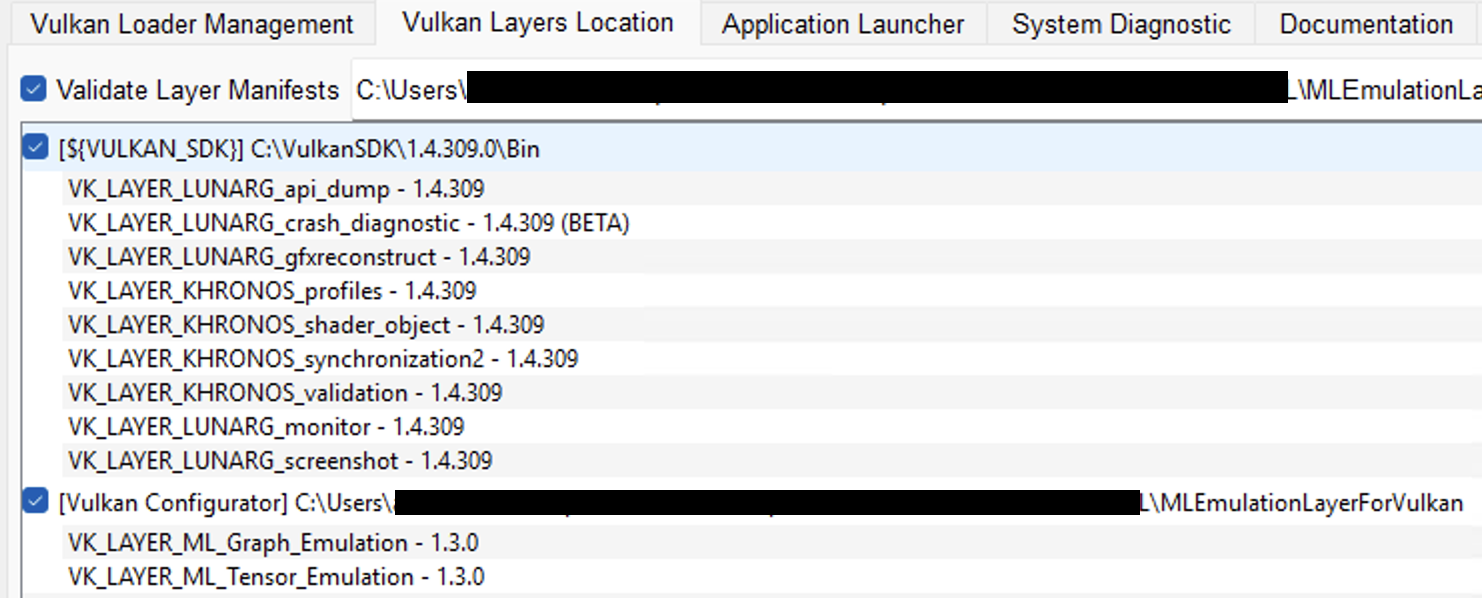 Figure 1: Add Vulkan layer path.
Confirm that
VK_LAYER_ML_Graph_EmulationandVK_LAYER_ML_Tensor_Emulationappear in the layer list.Switch back to the Vulkan Loader Management tab. Ensure the Graph layer is listed above the Tensor layer, and that you’ve set up the configuration scope as shown in the image.
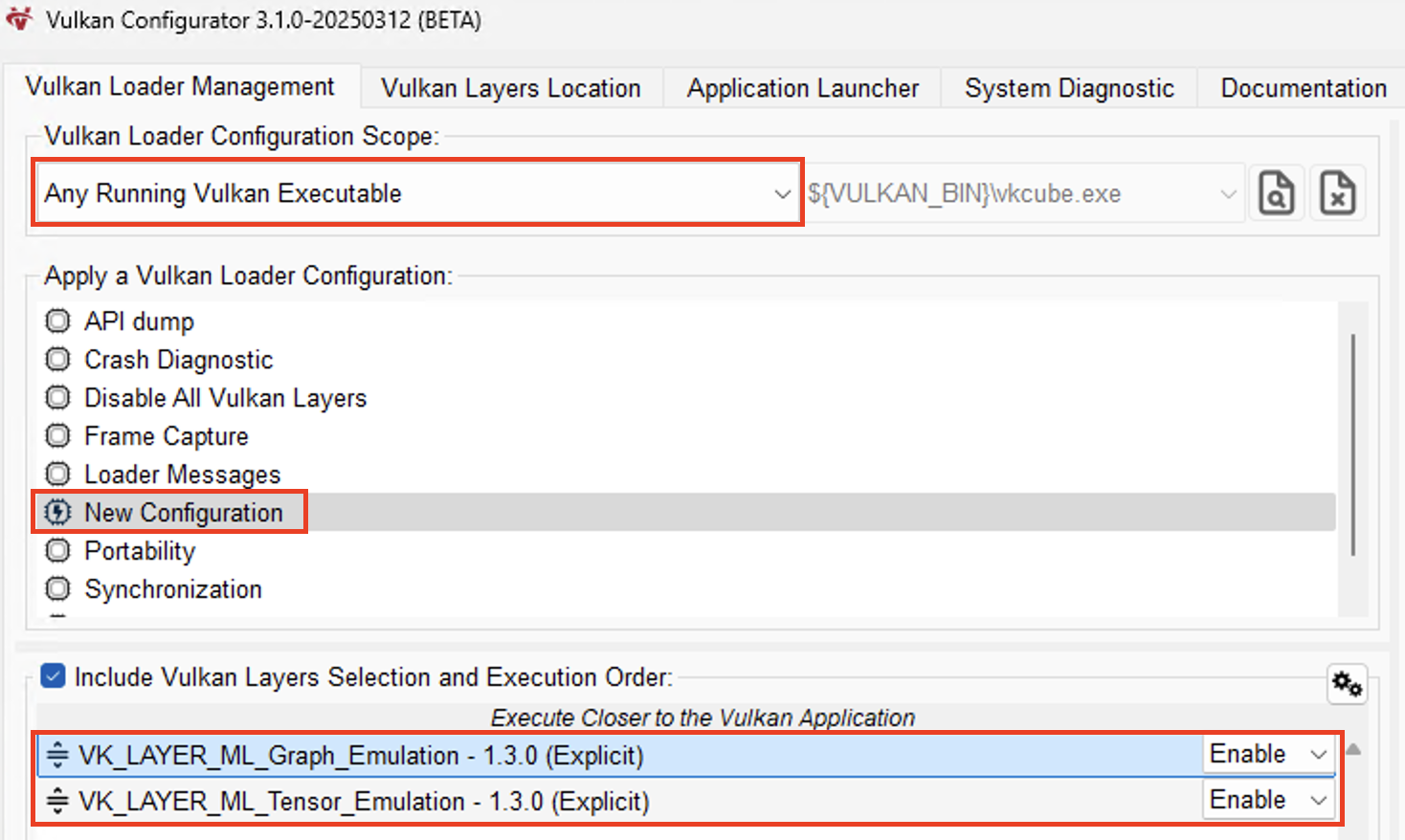 Figure 2: Verify layer ordering and scope.
Make sure you keep Vulkan Configurator running in the background as you go through the next steps.
With the standalone ML emulation layers configured, Vulkan can run machine learning workloads through the ML extensions for Vulkan. This enables neural inference to execute alongside the graphics pipeline during development, without requiring access to hardware with dedicated neural accelerators.
The next step is to integrate Neural Super Sampling into an Unreal Engine project. You’ll do this by installing the Arm Neural Graphics Plugin 1.1.0 and creating a simple example game that lets you verify the setup and visualize the upscaling in action.