Decode low-bit weights with Arm SME2 lookup-table instructions
Introduction
Understand why LUTI helps low-bit matrix multiplication
Use LUTI with SME2
Set up the SME2 environment
Compare plain C decoding with SME2 LUTI2
Build and validate the LUTI2 decoding example
Apply LUTI to SME2 matrix kernels
Build and validate the LUTI programming examples
Identify additional LUTI features
Next Steps
Decode low-bit weights with Arm SME2 lookup-table instructions
Introduction
Understand why LUTI helps low-bit matrix multiplication
Use LUTI with SME2
Set up the SME2 environment
Compare plain C decoding with SME2 LUTI2
Build and validate the LUTI2 decoding example
Apply LUTI to SME2 matrix kernels
Build and validate the LUTI programming examples
Identify additional LUTI features
Next Steps
Compare plain C and SME2
You’ll compare two ways to expand packed 2-bit right-hand side (RHS) values for signed 8-bit matrix multiplication with a lookup-table instruction (LUTI).
The plain C reference extracts each index with a shift and mask. It then uses
the index to select a signed 8-bit value from the lookup table. The SME2
implementation uses the LUTI2 instruction to expand one packed vector, and SMOPA to
accumulate four adjacent output panels in ZA0 to ZA3.
Both implementations use the same matrix dimensions, packed RHS bytes, and lookup table. The program compares their output matrices element by element.
Inspect the example
Open code/example_1_luti_decoding.c. The file contains both implementations and
the validation code. The following snippets highlight the sections to inspect
before you build the complete example.
Inspect the matrix shape
The example derives its matrix dimensions from the streaming vector length (SVL). SVL is the number of bits in one streaming vector.
Use the following relationships when reasoning about the dimensions:
svcntb()returns the number of bytes in one streaming vector.svcntw()returns the number of 32-bit words in one streaming vector.- One 32-bit word contains four bytes, so
svcntb() = 4 * svcntw().
The helper uses __arm_locally_streaming to query the streaming vector length:
__arm_locally_streaming static size_t streaming_vector_words(void) {
    return svcntw();
}
The example uses that value to define the matrix shape:
const size_t m = streaming_vector_words();  // svcntw()
const size_t n = 4 * m;                     // svcntb()
Both implementations calculate the following:
DST[M, N] = LHS[M, K] x RHS[K, N]
M is the number of 32-bit words for one streaming vector: M = svcntw().
N is the number of bytes in one streaming vector: N = svcntb(), which is equivalent to N = 4 * M.
The example fixes K = 4 for two related reasons. First, LUTI2 uses 2-bit lookup indices, so one packed RHS byte contains four 2-bit groups.
Those four groups provide the four RHS values along the K dimension for one output column.
Second, with M = svcntw(), setting K = 4 makes the M * K signed 8-bit left-hand side (LHS) block occupy exactly one streaming vector.
For an SVL of 512 bits:
- M = svcntw() = 512 / 32 = 16
- N = svcntb() = 512 / 8 = 64
- K = 4
| Block | Calculation | Size |
|---|---|---|
| LHS | M * K = 16 * 4 | 64 signed 8-bit values |
| Logical RHS | K * N = 4 * 64 | 256 2-bit codes |
| Packed RHS | 256 * 2 bits = 512 bits | 64 bytes |
| DST | M * N = 16 * 64 | 1024 signed 32-bit values |
The complete LHS block and packed RHS block each fit in one streaming Z register.
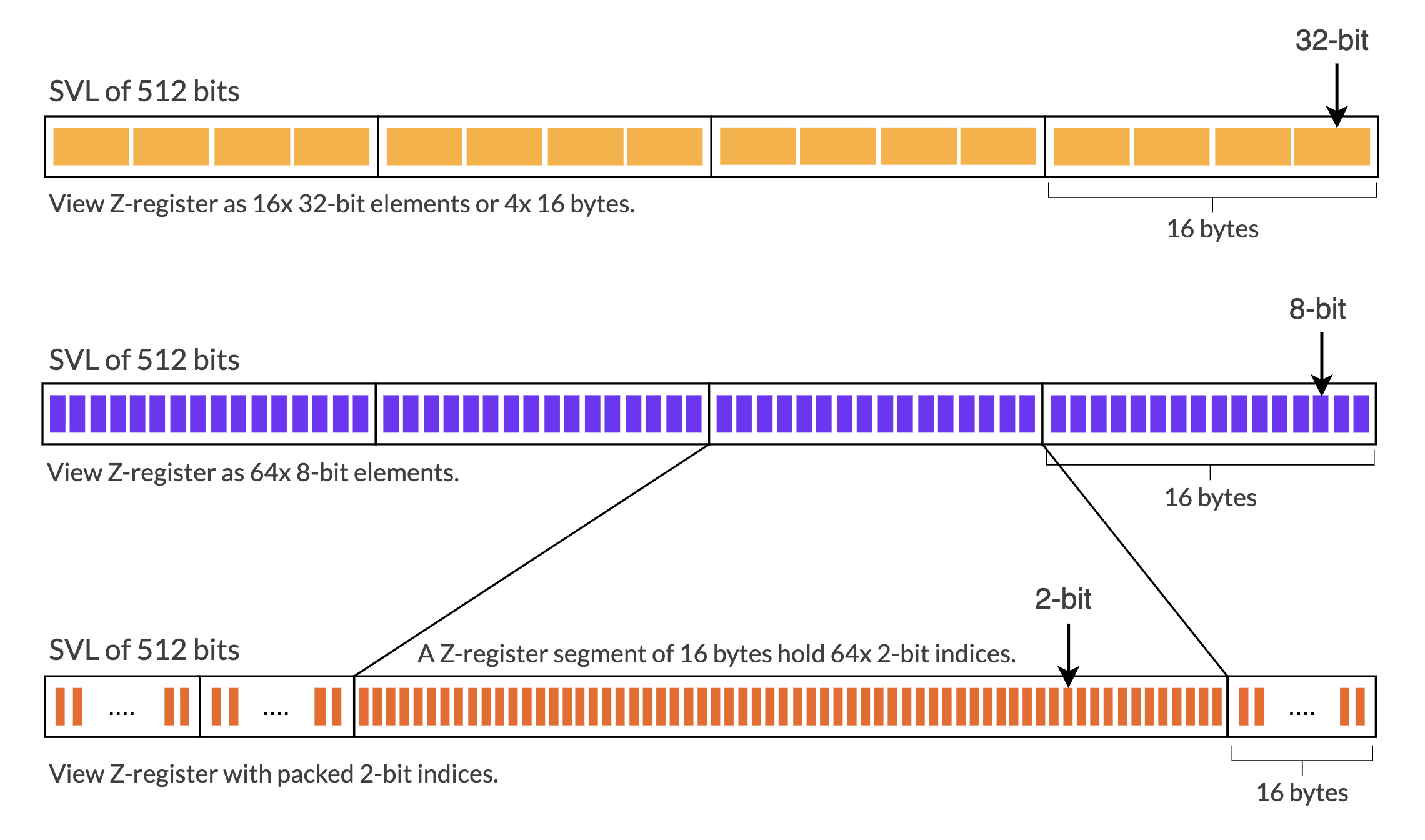 Three views of a 512-bit Z register showing how element width determines M and N
Low-bit packed format
For each output column, the packed RHS stores the four K dimension RHS values in one byte: rhs_packed[col].
LUTI2 uses 2-bit indices, so the byte is split into four 2-bit groups. Each group selects the lookup-table value for one RHS element, RHS[k, col]:
rhs_packed[col]
bits         [7:6] |    [5:4] |    [3:2] |    [1:0]
RHS:      [k3,col] | [k2,col] | [k1,col] | [k0,col]
The example reads the 2-bit groups from the least-significant bits first. For example:
packed byte:  0xE4 = 11_10_01_00
                      |  |  |  |
                      k3 k2 k1 k0

lookup indices read in k order: 0, 1, 2, 3
The example uses these constants in both implementations:
enum {
    K = 4,
    LUT_INDICES_PER_BYTE = 4,
};
Inspect the lookup table
The example uses the following mapping:
2-bit code  index  signed 8-bit value  raw byte
    00         0            -3          0xFD
    01         1            -1          0xFF
    10         2             1          0x01
    11         3             3          0x03
static const int8_t lut_i8_i2[16] = {
    -3, -1, 1, 3,
     0,  0, 0, 0,
     0,  0, 0, 0,
     0,  0, 0, 0,
};
The 2-bit indices select only entries 0 to 3. Entries 4 to 15 remain zero.
Inspect the plain C reference
The plain C reference calculates one output element at a time. It reads one packed RHS byte for each column.
For each k position, the inner loop shifts
the corresponding 2-bit field into bits [1:0]. The loop applies the 0x03 mask
and uses the result to index lut_i8_i2:
static void plain_c_matmul(
    const int8_t* lhs,
    const uint8_t* rhs_packed,
    int32_t* dst,
    size_t m,
    size_t n) {

    // Iterate over the output rows and columns.
    for (size_t row = 0; row < m; ++row) {
        for (size_t col = 0; col < n; ++col) {

            // Read the packed byte for this output column.
            const uint8_t packed_byte = rhs_packed[col];

            // Initialize the accumulator for this output element.
            int32_t acc_sum = 0;

            for (size_t k_idx = 0; k_idx < K; ++k_idx) {
                // Extract the 2-bit lookup table index for this k position.
                const unsigned bit_shift = 2U * (unsigned)k_idx;
                const uint8_t lut_idx = (uint8_t)((packed_byte >> bit_shift) & 0x3U);
                const int8_t expanded_byte = lut_i8_i2[lut_idx];

                // Widen the LHS and RHS values before multiplication.
                const int32_t lhs_value = (int32_t)lhs[row * K + k_idx];
                const int32_t expanded_rhs_value = (int32_t)expanded_byte;

                acc_sum += lhs_value * expanded_rhs_value;
            }

            // Store the accumulator in the corresponding output element.
            dst[row * n + col] = acc_sum;
        }
    }
}
For each output element, the loop implements:
DST[row, col] = sum(k=0..3) LHS[row, k] * RHS[k, col]
The program uses this implementation as the correctness reference. The innermost loop shifts, masks, looks up, and multiplies each value.
Inspect the SME2 LUTI2 implementation
The following snippets highlight the sections of the SME2 LUTI2 implementation that you should inspect.
Review how the same lookup values are stored in ZT0
The SME2 path uses the same logical lookup values. ZT0 has a fixed physical
layout of sixteen 32-bit entries (64 bytes):
static const int32_t zt0_table[16] __attribute__((aligned(64))) = {
    -3, -1, 1, 3,
     0,  0, 0, 0,
     0,  0, 0, 0,
     0,  0, 0, 0,
};
LUTI2 .B selects entries 0 to 3 and copies the low byte of each selected
32-bit entry. The low bytes of ZT0 entries 0 to 3 therefore match the bit
patterns in the plain C table for the four signed 8-bit values.
Review how a locally streaming SME function is declared
The following attributes tell the compiler to run the function body in streaming
mode and provide new ZA and ZT0 state for the function:
__arm_new("za", "zt0") __arm_locally_streaming
Follow the SME2 compute path
Review the following SME2 implementation:
__arm_new("za", "zt0") __arm_locally_streaming
static void luti2_sme2_asm_matmul(const int8_t *lhs,
                                  const uint8_t *rhs_packed,
                                  int32_t *dst, size_t m, size_t n) {
    __asm__ volatile(
        "ptrue p0.b\n"
        "ldr zt0, [%[table]]\n"     // Load the lookup table into ZT0
        "zero {za}\n"               // Clear all ZA accumulator state

        // Load one streaming vector from each input.
        "ld1b {z0.b}, p0/z, [%[lhs]]\n"
        "ld1b {z1.b}, p0/z, [%[rhs]]\n"

        // Expand one packed source vector into four signed 8-bit vectors.
        "luti2 {z4.b-z7.b}, zt0, z1[0]\n"

        // Accumulate four adjacent M-by-M output panels in ZA0-ZA3.
        "smopa za0.s, p0/m, p0/m, z0.b, z4.b\n"
        "smopa za1.s, p0/m, p0/m, z0.b, z5.b\n"
        "smopa za2.s, p0/m, p0/m, z0.b, z6.b\n"
        "smopa za3.s, p0/m, p0/m, z0.b, z7.b\n"
        :
        : [lhs] "r"(lhs),
          [rhs] "r"(rhs_packed),
          [table] "r"(zt0_table)
        : "p0", "z0", "z1", "z4", "z5", "z6", "z7",
          "za", "zt0", "memory");

    // Read four vectors from ZA and store them.
    for (uint32_t row = 0; row < m; ++row) {
        svint8x4_t read_tiles = svread_hor_za8_s8_vg4(0, 4 * row);
        svint32x4_t output_tiles = svreinterpret_s32_s8_x4(read_tiles);
        svst1_s32_x4(
            svptrue_c32(),
            dst + (size_t)row * n,
            output_tiles);
    }
}
Inline assembly loads ZT0, expands
the packed RHS, and accumulates four output panels. Arm C Language Extensions (ACLE) intrinsics read ZA
and store the output matrix.
The inline assembly loads the lookup table into ZT0 and loads one vector
from each input. LUTI2 expands the packed RHS into four vectors. Four
SMOPA instructions accumulate those vectors into ZA0 to ZA3.
The output loop reads one horizontal row across ZA0 to ZA3. It
reinterprets the returned bytes as four vectors of int32_t accumulators and
stores them as one contiguous output row.
LUTI2 doesn’t perform the multiplication. The packed RHS stays compact until the matrix kernel needs it. The expanded values then pass directly from Z registers to SME2 matrix instructions.
To see the same instruction pattern in production code, inspect the
qai8dxp_qsu2cxp Arm KleidiAI micro-kernel source
.
Check your understanding
Before continuing, make sure that you understand the following:
- Why one packed byte represents four values along the
Kdimension. - Why the plain C shift counts are 0, 2, 4, and 6.
- Why the mask is
0x03. - How one LUTI2 produces four decoded Z registers.
- Why four
SMOPAinstructions produce four adjacent output panels inZA0toZA3. - How the element-by-element comparison validates the SME2 result.
What you’ve learned and what’s next
You’ve seen how plain C and SME2 LUTI2 decode the same packed 2-bit RHS data.
You’ve also traced how the expanded Z-register values pass directly to SMOPA
and accumulate signed 32-bit results in ZA.
Next, you’ll build the first example and validate that both implementations produce the same result.