Decode low-bit weights with Arm SME2 lookup-table instructions
Introduction
Understand why LUTI helps low-bit matrix multiplication
Use LUTI with SME2
Set up the SME2 environment
Compare plain C decoding with SME2 LUTI2
Build and validate the LUTI2 decoding example
Apply LUTI to SME2 matrix kernels
Build and validate the LUTI programming examples
Identify additional LUTI features
Next Steps
Decode low-bit weights with Arm SME2 lookup-table instructions
Introduction
Understand why LUTI helps low-bit matrix multiplication
Use LUTI with SME2
Set up the SME2 environment
Compare plain C decoding with SME2 LUTI2
Build and validate the LUTI2 decoding example
Apply LUTI to SME2 matrix kernels
Build and validate the LUTI programming examples
Identify additional LUTI features
Next Steps
SME and SME2 architectural features
Arm Scalable Matrix Extension (SME) extends the Armv9-A architecture and accelerates matrix-heavy computations, such as outer products and matrix multiplication.
SME introduces Streaming Scalable Vector Extension (SVE) mode and the scalable ZA matrix-storage array. ZA accumulates matrix outer products and multi-vector dot products.
SME2 builds on SME and adds multi-vector instructions and the fixed 512-bit ZT0 lookup-table register.
Lookup-table instructions (LUTIs) use packed low-bit codes from Z source registers. They read the corresponding lookup table entries from ZT0, and write expanded operands into Z destination registers.
The expanded operands can then be consumed by SME2 matrix instructions such as SDOT or SMOPA, with results accumulated in the ZA array.
ZT0 lookup-table register
SME2 provides a fixed 512-bit architectural register named ZT0. It contains 64 bytes, arranged as sixteen 32-bit table entries.
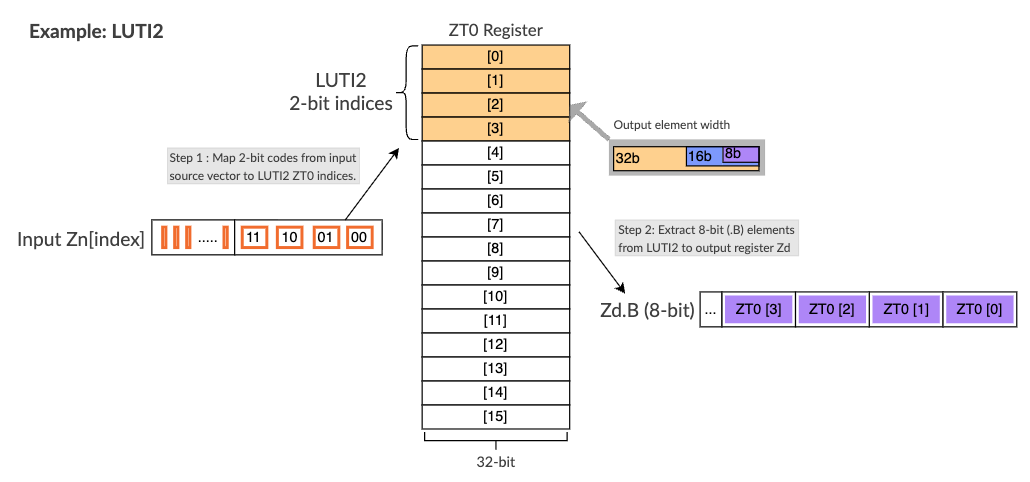 ZT0 lookup-table organization used by LUTI2
LUTI4 works the same way but uses 4-bit indices, giving access to all sixteen entries and producing wider output elements.
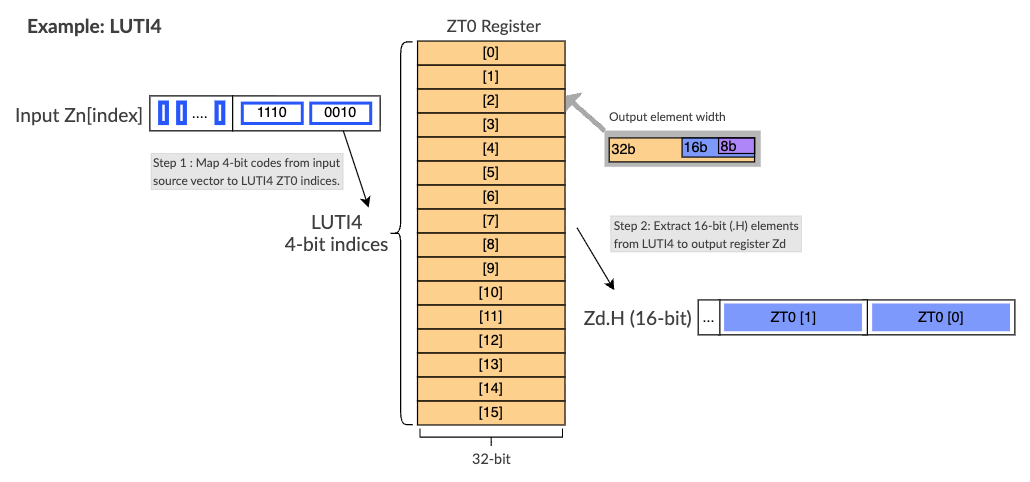 ZT0 lookup-table organization used by LUTI4
LUTIs use packed low-bit indices from a source Z register (Zn) to select the corresponding ZT0 register entry.
The relevant ZT0 entries are expanded to the chosen destination element width and written to output Z registers (Zd).
LUTI2 and LUTI4 can populate one, two, or four destination Z registers. The number of destination registers and the expanded element width (.B, .H, or .S) determine how many packed source bits fill the destinations.
The element suffix specifies the expanded destination width:
.Bproduces 8-bit elements..Hproduces 16-bit elements..Sproduces 32-bit elements.
Streaming mode
ZT0-based SME2 LUTIs need both streaming mode and ZA enabled. SMSTART enables the required state, and SMSTOP disables it.
Streaming mode changes the execution context in three ways:
- Vector and predicate lengths use the streaming vector length (SVL), which can differ from the non-streaming vector length.
- Streaming instructions, including the multi-register LUTI2, SDOT, and SMOPA forms, become available.
PSTATE.ZAcontrols access to both the ZA matrix-storage array andZT0.
Efficient kernels enter streaming mode before repeated loops and exit afterwards. Streaming mode doesn’t automatically stream matrix data from memory. The kernel still loads only the current computation tile.
Follow the SME2 LUTI data path
A simplified SME2 LUTI sequence is:
SMSTART
* load ZT0 once
* perform LUTI2
SMSTOP
A detailed LUTI SME2 flow is:
- Enter SME streaming mode with
SMSTARTand load the LUT into the sixteen 32-bitZT0register. - Load left-hand side (LHS) activations and packed right-hand side (RHS) data for the current computation tile.
- Use LUTI2 or LUTI4 to expand the packed RHS indices from
ZT0into Z registers. - Feed the expanded RHS elements and LHS activations to SME2 instructions, such as
SDOTorSMOPA. - Accumulate partial matrix products in the SME2
ZAarray. - Convert, clamp, and store the completed output tile as required by the kernel.
- Exit SME streaming mode with
SMSTOP. This disables the ZA and ZT0 state after the kernel completes.
LUTI replaces the explicit unpack and decode portion of the data path. It doesn’t replace the matrix multiply instruction that consumes the expanded values.
Example kernel with LUTI2
The following example kernel shows how LUTI2 expands packed 2-bit RHS weights. It simplifies register allocation, predication, addressing, and loop control to focus on the LUTI data flow.
Define and pass the lookup table
ZT0 contains sixteen 32-bit entries. LUTI2 uses entries 0 to 3:
static const int32_t lut_i8_i2[16] = {-2, -1, 0, 1,};
Entries 4 to 15 are unused and contain zero.
For a .B LUTI result, the low 8 bits of the selected 32-bit entry form the destination element.
Load the lookup table into ZT0
Enter streaming mode, initialize ZA, and load ZT0. The lookup table doesn’t change across the inner matrix loop, so load it once before the loop:
smstart                   // Enable Streaming SVE mode and ZA/ZT0 state
zero    {za}              // Zero initialize accumulators for this output tile
ldr     zt0, [lut_i8_i2]      // load LUT into fixed 512-bit ZT0 table
Load LHS and packed RHS
Load the LHS activations and packed RHS 2-bit indices for the current computation tile, not the entire matrix:
ld1rqb  {z0.b}, ... , [x_lhs]               // load LHS
ld1b    {z16.b-z19.b}, ... , [x_packed_rhs] // load RHS packed 2-bit indices
- The
z0.bregister receives the LHS activations. - The
z16.b–z19.bregisters receive the packed RHS 2-bit indices.
ld1rqb is the SVE load-and-replicate-quadword operation. For a 512-bit SVL, you can view z0 as four 128-bit regions. ld1rqb replicates the 16-byte LHS block across those regions.
LUTI2 expands the packed indices
Each LUTI2 instruction reads packed 2-bit indices from one source Z register (z16 to z19) and expands them into four .B destination registers for a 512-bit SVL:
luti2   { z24.b - z27.b }, zt0, z16[0]     // unpack 2-bit indices
luti2   { z4.b  - z7.b  }, zt0, z17[0]
luti2   { z8.b  - z11.b }, zt0, z18[0]
luti2   { z12.b - z15.b }, zt0, z19[0]
Feed the expanded vectors directly to SDOT
The expanded vectors can now feed SME2 matrix instructions such as SDOT or SMOPA, which accumulate the results in ZA.
What you’ve learned and what’s next
You’ve learned how LUTI operates within SME2. A micro-kernel loads the lookup table into ZT0. It uses packed low-bit indices in Z registers to expand the RHS values, and feeds those expanded values into SME2 instructions.
Next, you’ll select and prepare a macOS or Android SME2 environment for the SME2 LUTI examples.