Accelerate LiteRT Models on Android with KleidiAI and SME2
Introduction
Explore LiteRT, XNNPACK, KleidiAI, and SME2
Create LiteRT models
Build the LiteRT benchmark tool
Benchmark the LiteRT model
Next Steps
Accelerate LiteRT Models on Android with KleidiAI and SME2
Inside the LiteRT software stack
LiteRT (Lite Runtime, formerly TensorFlow Lite) is a runtime for on-device AI. The default CPU acceleration library used by LiteRT is XNNPACK.
XNNPACK is an open-source library that provides highly optimized implementations of neural-network operators. It continuously integrates the KleidiAI library to use new CPU features such as Scalable Matrix Extension 2 (SME2).
KleidiAI is a library developed by Arm that offers performance-critical micro-kernels using Arm architecture features, such as SME2.
The software stack for LiteRT is shown below.
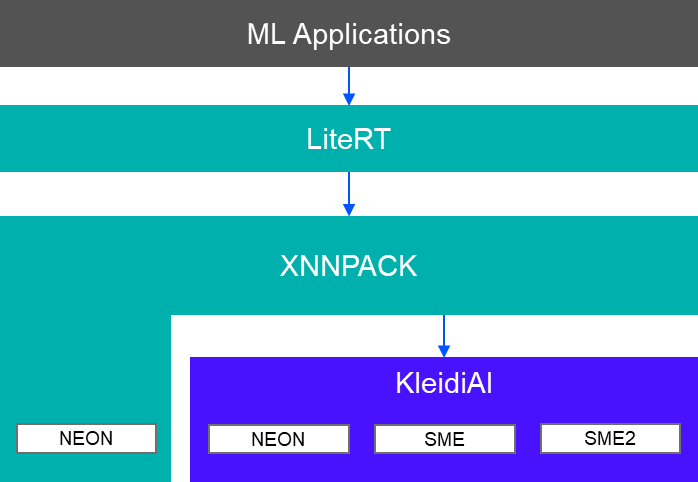 LiteRT, XNNPACK, KleidiAI, and SME2 software stack
How KleidiAI works in LiteRT
To understand how KleidiAI SME2 micro-kernels work in LiteRT, think about a LiteRT model with one fully connected operator using the FP32 data type. The following diagrams illustrate the execution workflow of XNNPACK’s implementation compared with the workflow when KleidiAI SME2 is enabled in XNNPACK.
LiteRT → XNNPACK workflow
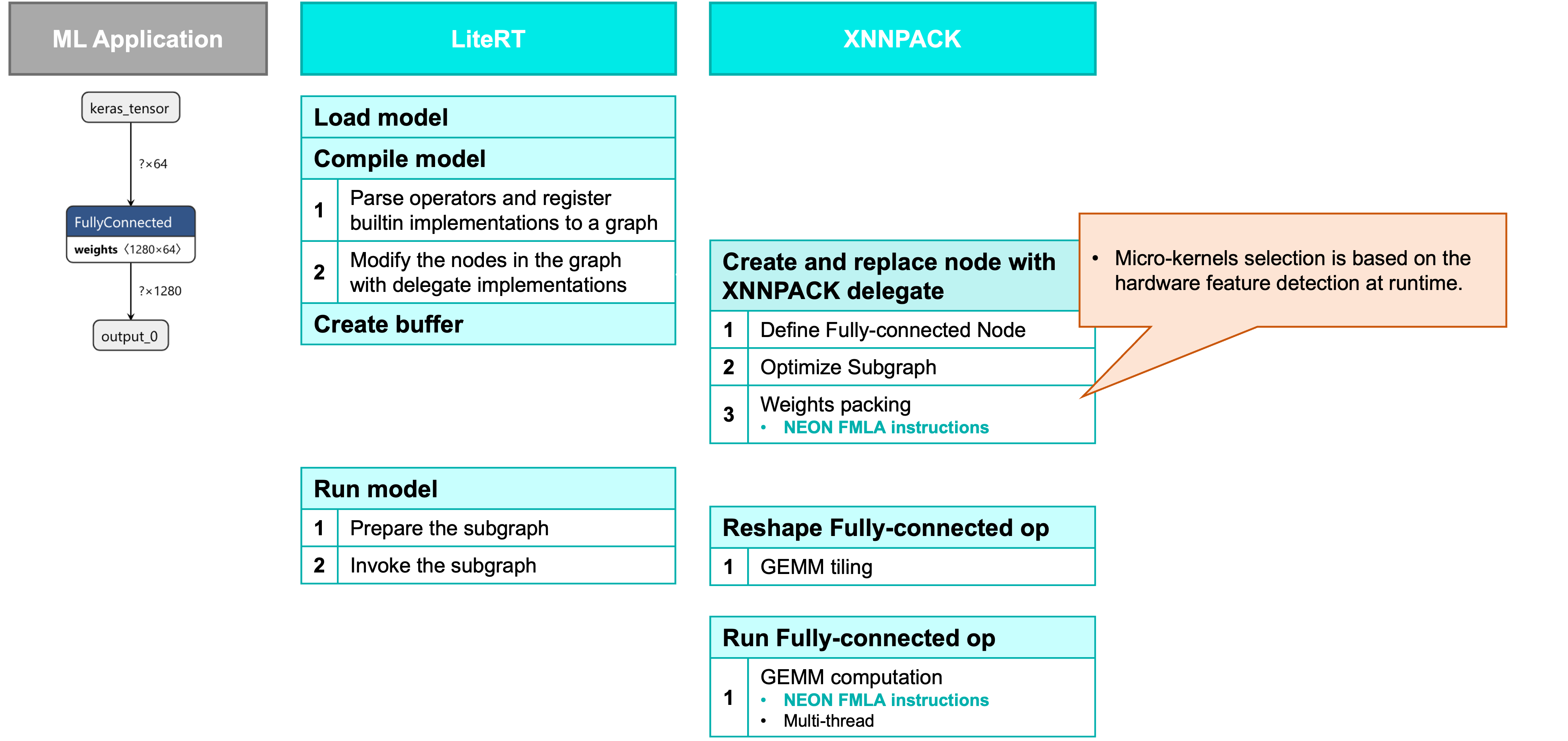 LiteRT, XNNPACK workflow
For batch sizes greater than 1, a fully connected operator performs a matrix multiplication between the input activations (LHS) and the weights (RHS).
LiteRT, XNNPACK workflow
For batch sizes greater than 1, a fully connected operator performs a matrix multiplication between the input activations (LHS) and the weights (RHS).
When LiteRT loads a model, it reads the operators and builds a computation graph. If you select the CPU as the accelerator, LiteRT uses XNNPACK by default.
XNNPACK scans the computation graph and looks for operators it can optimize. XNNPACK also checks the hardware compatibility and chooses the best available micro-kernel. Then, it packs the weight matrix to prepare for efficient computation. On Arm platforms, XNNPACK uses Neon instructions to speed up this packing.
During model inference, it splits the matrices into smaller tiles and runs the multiplications in parallel across multiple threads, using Neon instructions for faster processing.
LiteRT → XNNPACK → KleidiAI workflow
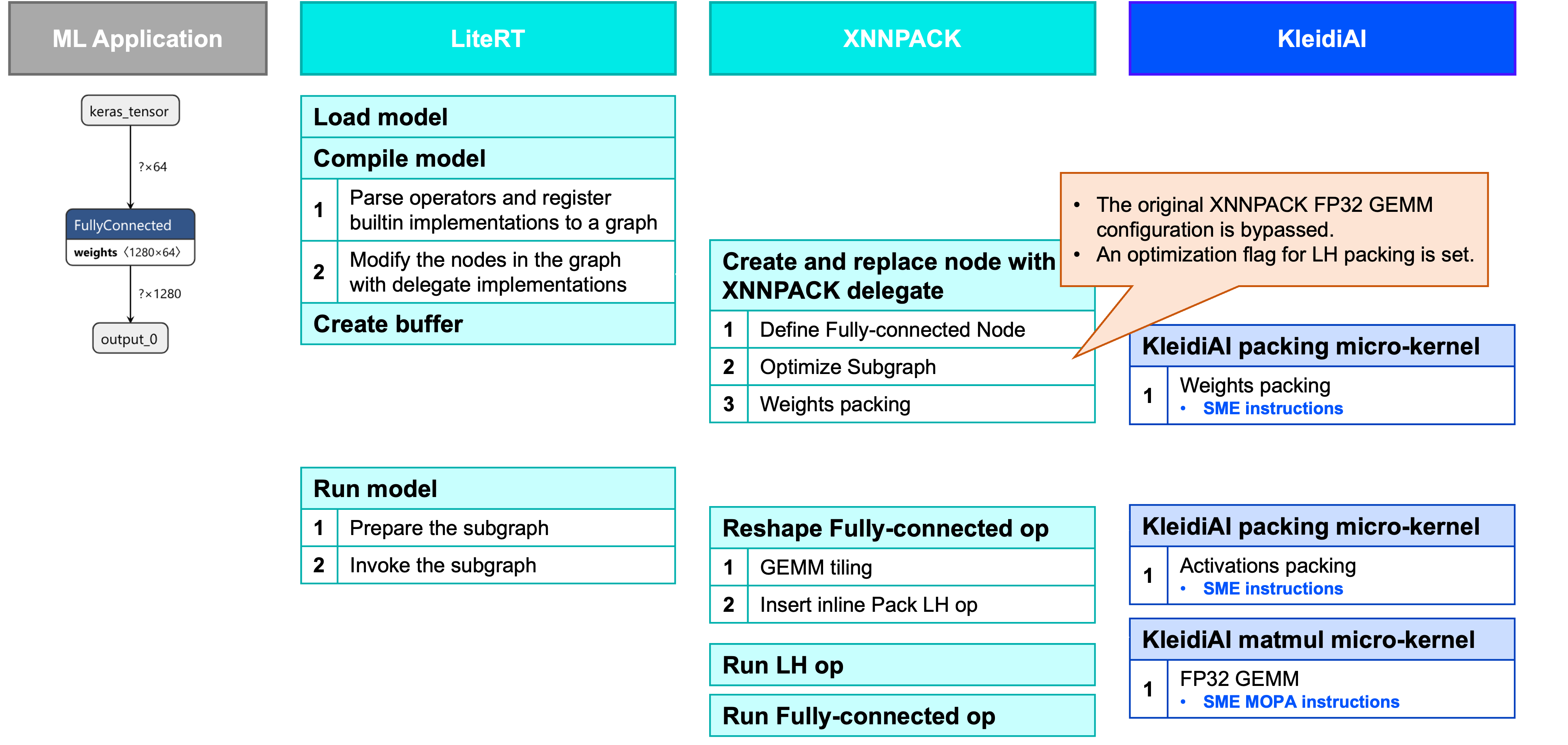 LiteRT, XNNPACK, KleidiAI workflow
When KleidiAI and SME2 are enabled at build time, the KleidiAI SME2 micro-kernels are compiled into XNNPACK.
During the model loading stage, when XNNPACK optimizes the subgraph, it checks the operator’s data type to determine whether a KleidiAI implementation is available. If KleidiAI supports it, XNNPACK bypasses its own default implementation. As a result, RHS packing is performed using the KleidiAI SME packing micro-kernel. Because KleidiAI typically requires packing of the LHS, a flag is also set during this stage.
During model inference, the LHS packing micro-kernel is invoked. After the LHS is packed, XNNPACK performs the matrix multiplication. At this point, the KleidiAI SME micro-kernel is used to compute the matrix.
What you’ve accomplished and what’s next
In this section, you explored how LiteRT leverages XNNPACK and KleidiAI to accelerate fully connected operators on Arm platforms. You learned how XNNPACK uses Neon instructions for efficient matrix operations and how enabling KleidiAI with SME2 further optimizes performance by introducing specialized micro-kernels for packing and matrix multiplication.
You have completed the overview of LiteRT, XNNPACK, KleidiAI, and SME2 integration. Next, you’ll dive deeper into building and benchmarking models with these technologies.