SME2 INT8 MOPA for matmul
SME2 INT8 MOPA (outer product accumulate) instructions compute the sum of outer products for INT8 inputs, widen the results into INT32, and accumulate into an SME2 tile in the ZA storage.
Understand what MOPA computes
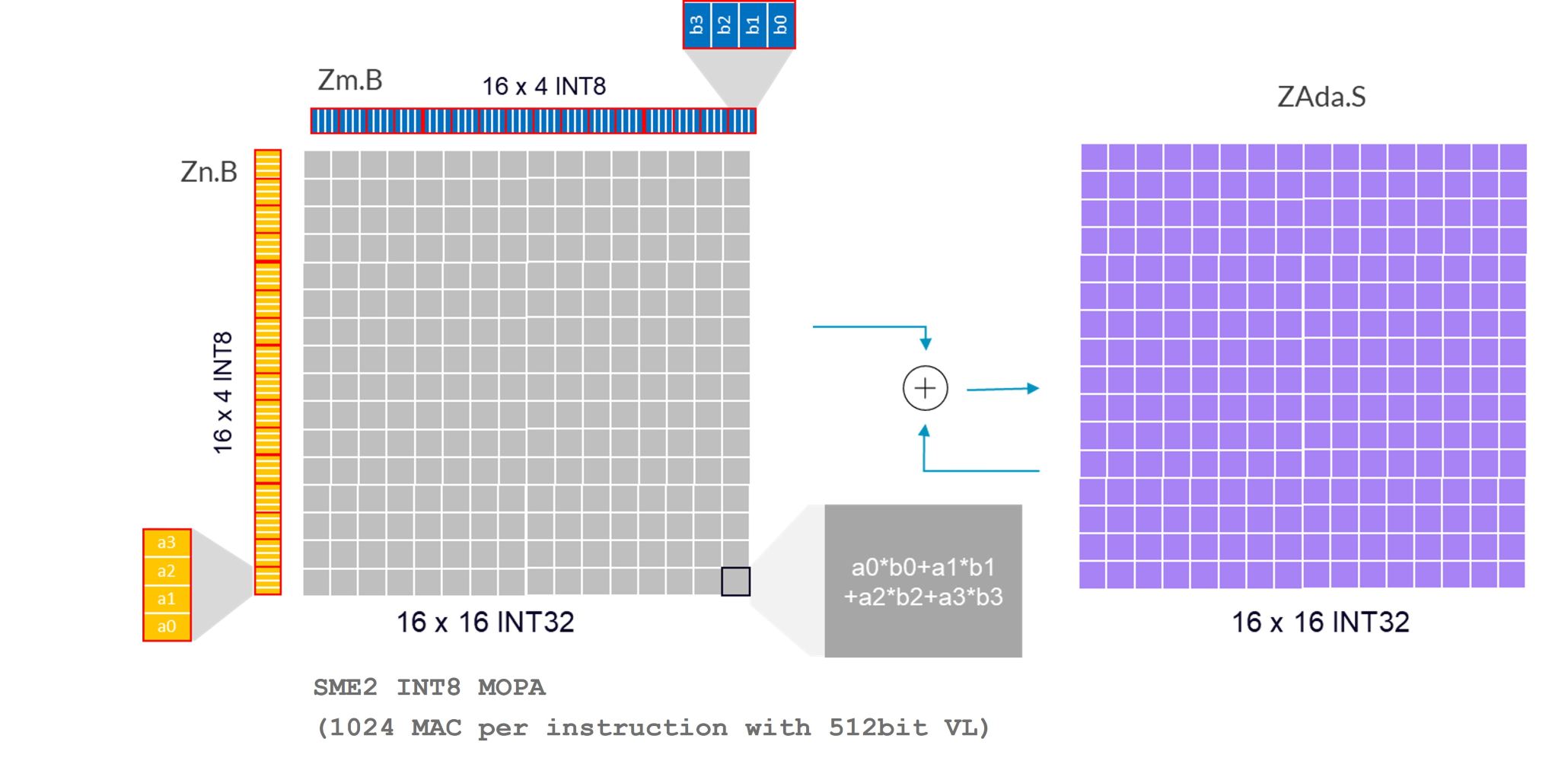 SME2 INT8 MOPA instruction
When the SME2 streaming vector length (SVL) is 512 bits, each input register (Zn.B, Zm.B) can be treated as a matrix of 16×4 INT8 elements (with a hardware-defined arrangement).
- The first source, Zn.B contains a 16x4 sub-matrix of 8-bit integer values.
- The second source, Zm.B, contains a 16 x4 sub-matrix of 8-bit integer values.
- The INT8 MOPA instruction calculates a 16×16 widened INT32 sum of outer products, then destructively adds it to the INT32 destination tile,
ZAda.
The video below shows how SME2 INT8 Outer Product Accumulate instructions are used for matrix multiplication.
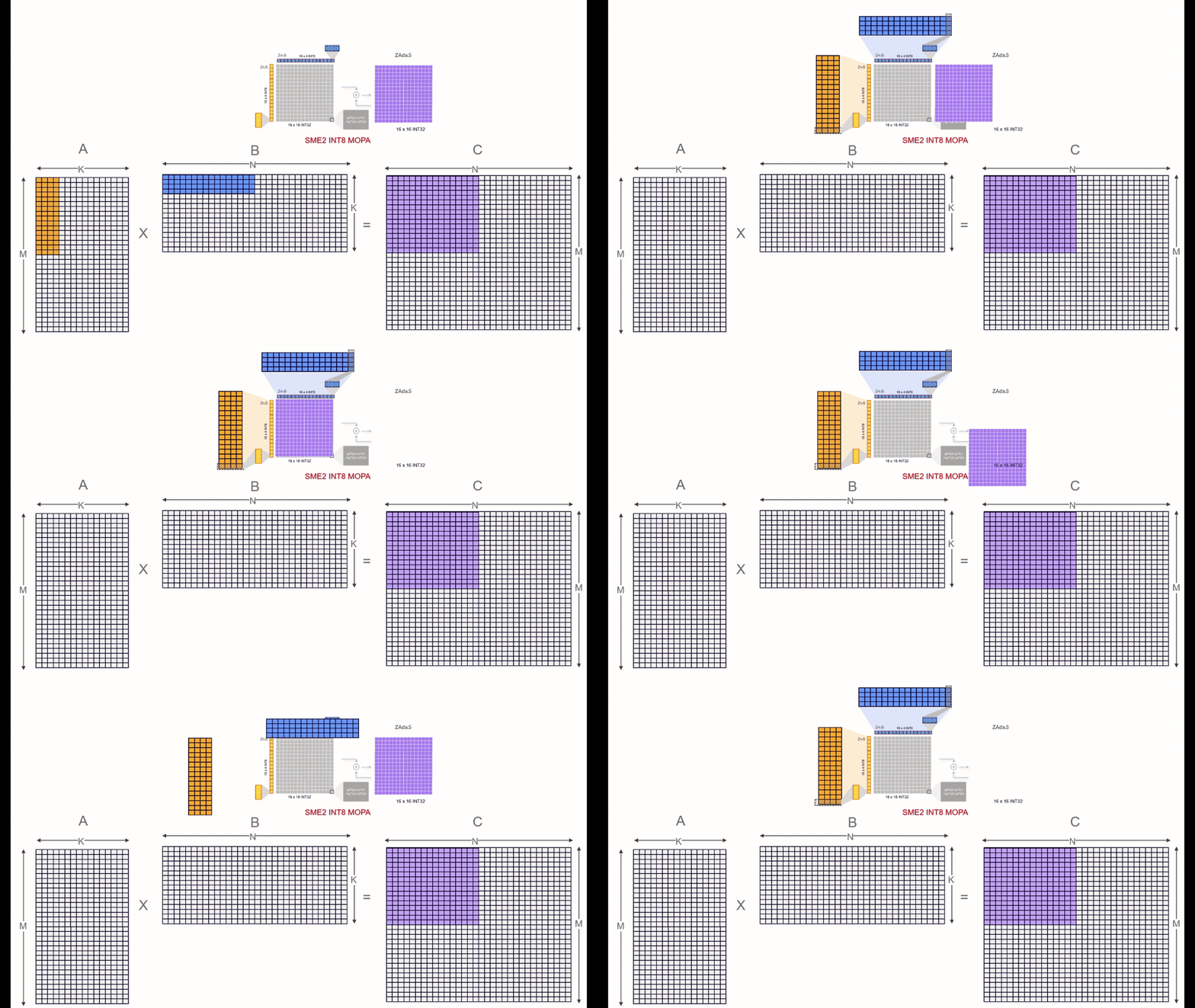 Matrix Multiplication with 1VLx1VL SME2 MOPA
Map MOPA to a 16×16 output tile
To calculate the result of a 16×16 submatrix in matrix C (element type: INT32):
First,
- a 16x4 sub-matrix in matrix A (element type: INT8) is loaded to a SME2 Z register,
- a 4x16 sub-matrix in matrix B (element type: INT8) is loaded to another SME2 Z register
- a 16x16 sub-matrix in matrix C is stored in an SME2 ZA tile, which is initialized to zero only once
Then, the SME2 INT8 MOPA instruction uses the data from these two Z registers to perform the outer product operation and accumulates the results into the ZA tile, which holds the 16x16 sub-matrix of matrix C, thus obtaining an intermediate result for this 16x16 sub-matrix.
Iterate over the K dimension, repeatedly loading 16x4 submatrices from matrix A and 4×16 submatrices from matrix B. For each step, use the SME2 INT8 MOPA instruction to compute outer products and accumulate the results into the same ZA tile. After completing the iteration over K, this ZA tile holds the final values for the corresponding 16×16 submatrix of matrix C. Finally, store the contents of the ZA tile back to memory.
Apply the same process across the M and N dimensions to compute the full output matrix.
Apply the same process to all 16x16 sub-matrices in matrix C to complete the entire matrix computation.
See the 1VL×4VL pattern
To improve throughput, a microkernel can pipeline multiple MOPA instructions so that it accumulates into multiple ZA tiles in parallel. One common pattern is 1VL×4VL: one VL slice from the LHS multiplies four VL slices from the RHS in the same inner-loop iteration, accumulating into four ZA tiles.
The video below demonstrates how four pipelined MOPA instructions perform matrix multiplication of one 16×4 submatrix from matrix A and four 4×16 submatrices from matrix B in a single iteration (1VL×4VL).
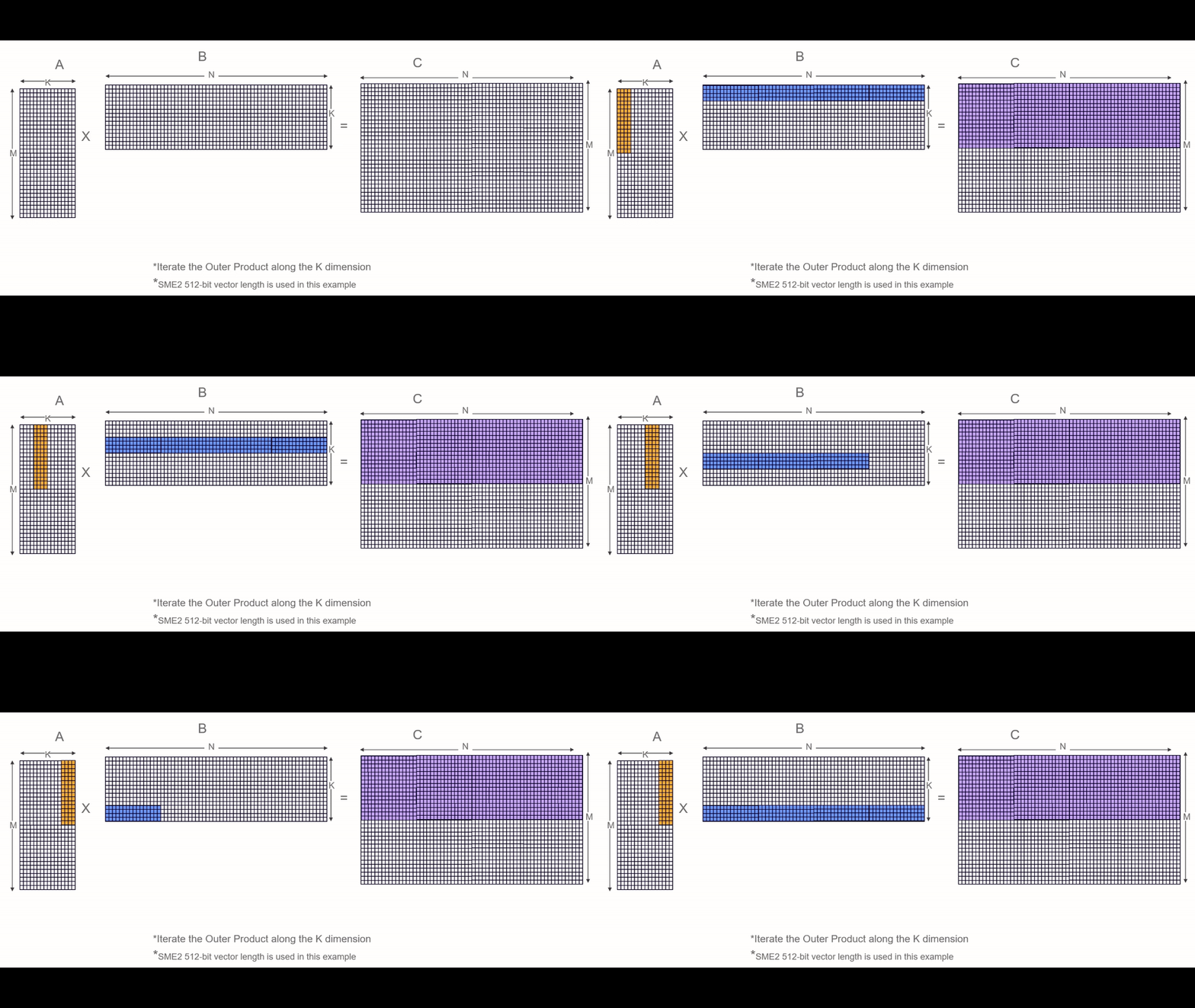 Matrix Multiplication with 1VLx4VL SME2 MOPA
The intermediate result of 4x16x16 output submatrix is held in four ZA.S tiles.
Matrix Multiplication with 1VLx4VL SME2 MOPA
The intermediate result of 4x16x16 output submatrix is held in four ZA.S tiles.
Hands-on: locate MOPA in the SME2 microkernel (optional)
If you cloned KleidiAI earlier, you can confirm that the SME2 matmul microkernel uses MOPA by searching for smopa instructions in the kernel source.
From the KleidiAI repo root:
KERNEL_FILE="kai/ukernels/matmul/matmul_clamp_f32_qsi8d32p_qai4c32p/kai_matmul_clamp_f32_qsi8d32p1vlx4_qai4c32p4vlx4_1vlx4vl_sme2_mopa_asm.S"
grep -n "smopa" "$KERNEL_FILE" | head
You’ll connect these smopa sites to the “load → dequantize → MOPA → dequantize” flow later in the example walk-through.
You can find more information about SME2 MOPA here,
- Part 1 Arm Scalable Matrix Extension Introduction
- Part 2 Arm Scalable Matrix Extension Instructions
- Part 4 Arm SME2 Introduction
What you’ve learned and what’s next
You’ve learned how SME2 INT8 MOPA instructions compute outer products for matrix multiplication and how the 1VL×4VL pattern pipelines four MOPA instructions to improve throughput. You can now connect MOPA operations to output tile shapes.
Next, you’ll decode the specific SME2 matmul microkernel name and understand what the format tags reveal about input layouts and tile dimensions.