Quantize and pack LHS activations
Next, the FP32 LHS (activation) needs to be quantized and packed when the llama.cpp graph runner computes the matmul nodes/operators.
Quantize and pack the LHS
Because the LHS (activations) changes for each matmul invocation, it must be quantized and packed dynamically. In this example, the FP32 LHS is quantized to signed INT8 and packed into the qsi8d32p1vlx4 format using the kai_run_lhs_quant_pack_qsi8d32p_f32_neon microkernel.
The function call stack for this process in llama.cpp is as follows:
llama_context::decode
   llama_context::process_ubatch
      llama_context::graph_compute
	     ggml_backend_sched_compute_splits
		    ggml_backend_cpu_graph_compute
			   ggml_graph_compute             //tick off the compute thread
			      ggml_graph_compute_thread   //the compute thread
				     ggml_compute_forward
					     ggml_cpu_extra_compute_forward
						    ggml::cpu::kleidiai::tensor_traits::compute_forward
							    ggml::cpu::kleidiai::tensor_traits::compute_forward_q4_0
								    kai_run_lhs_quant_pack_qsi8d32p_f32_neon
The diagram below illustrates how the LHS is quantized and packed by kai_run_lhs_quant_pack_qsi8d32p_f32_neon:
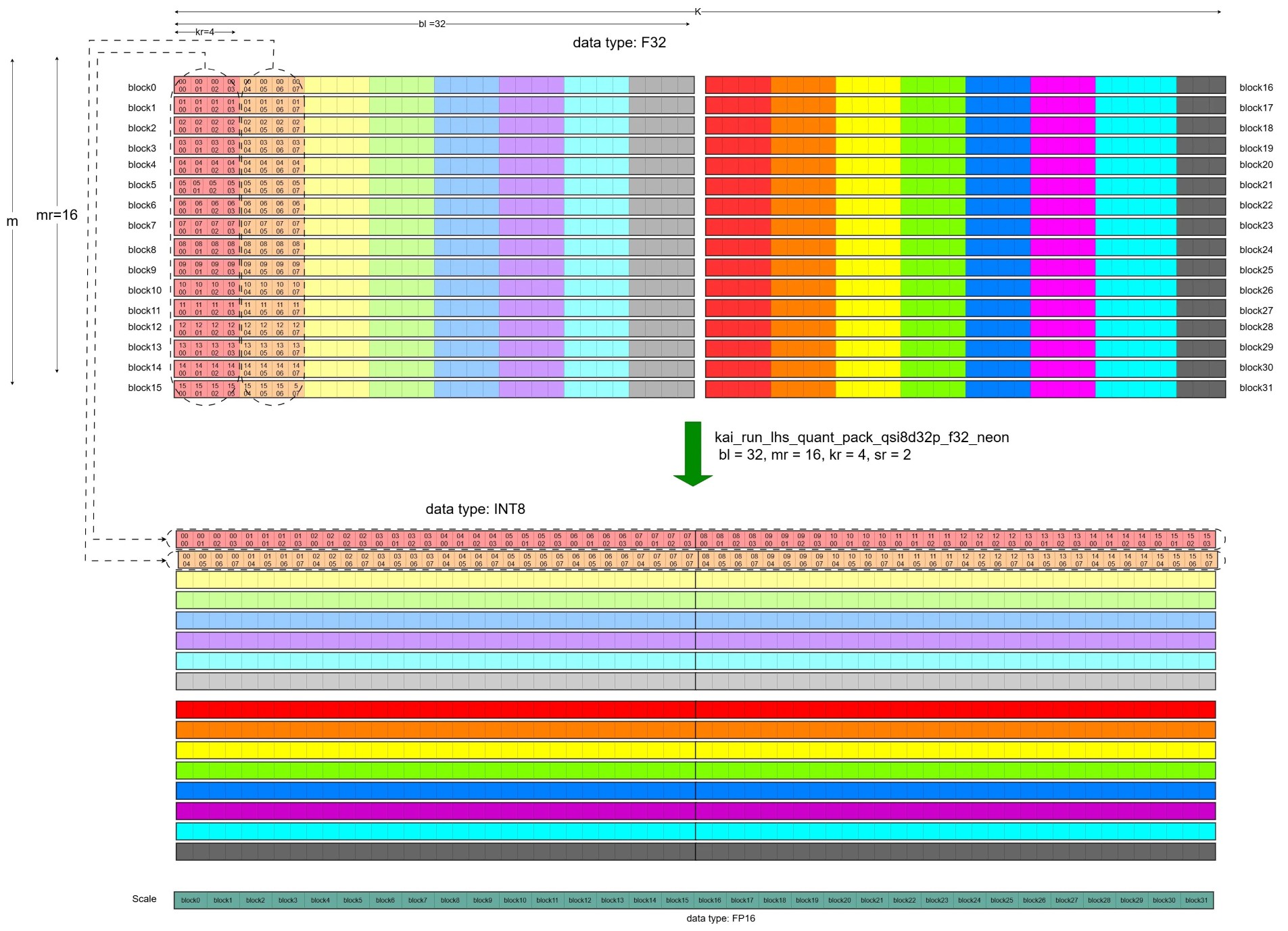 Quantization and Packing of the LHS
The values of mr, nr, and kr can be obtained in the same way as described above.
The values of mr, nr, and kr, together with the matrix dimensions m and k, are passed as parameters to kai_run_lhs_quant_pack_qsi8d32p_f32_neon.
This microkernel:
- Quantizes FP32 LHS values to signed INT8
- Stores the per-block scales
- Packs the quantized values into a contiguous layout based on
mr × krtiles (16 × 4 in this example)
This packing ensures the SME2 matmul microkernel can load a full input slice from contiguous memory, which improves cache locality.
Hands-on: locate the LHS quant-pack microkernel in KleidiAI (optional)
If you cloned the KleidiAI repository earlier, locate the LHS quantization + packing microkernel:
grep -R "kai_run_lhs_quant_pack_qsi8d32p_f32_neon" -n kai | head
What you’ve learned and what’s next
You’ve learned how the FP32 LHS activations are quantized to signed INT8 and packed into the qsi8d32p1vlx4 format during inference. You understand how this dynamic packing enables efficient contiguous memory access in the SME2 microkernel.
Next, you’ll walk through the SME2 matmul microkernel inner loop to see how packed LHS and RHS feed the MOPA instructions.