Run optimized object-detection models from the Arm AI Portal on Android
Introduction
Prepare the Android command-line tools for building Scene Detector
Connect an Arm-based Android device and run Scene Detector
Import and run an Arm AI Portal object-detection model
Understand the Scene Detector Android application
(Optional) Use an object-detection model not currently supported by Scene Detector
Next Steps
Run optimized object-detection models from the Arm AI Portal on Android
Introduction
Prepare the Android command-line tools for building Scene Detector
Connect an Arm-based Android device and run Scene Detector
Import and run an Arm AI Portal object-detection model
Understand the Scene Detector Android application
(Optional) Use an object-detection model not currently supported by Scene Detector
Next Steps
Connect an Android phone
Enable Developer options and USB debugging on the phone. Connect it to your development computer with USB, unlock it, and accept the debugging authorization prompt.
Verify that your phone is listed in adb:
adb devices -l
The output lists the authorized phone and its device serial. If the phone reports unauthorized, unlock it and accept the debugging prompt. If the phone doesn’t appear, see
Run apps on a hardware device
.
On Linux, a phone that doesn’t appear in adb might need Android udev rules and membership in the plugdev group. On Windows, you might need the phone manufacturer’s USB driver. You don’t normally need an additional USB driver on macOS.
Clone the application repository
Clone the repository with Git, then enter the project directory:
git clone https://github.com/arm-education/ai-portal-android-app-object-detection.git
cd ai-portal-android-app-object-detection
Run the remaining terminal commands from this project directory.
Prepare the Arm AI Portal model downloader
The sample repository includes a downloader for its supported Arm AI Portal model packages.
Create a Python virtual environment and install the package used by the downloader:
python3 -m venv .hf-venv
.hf-venv/bin/python -m pip install --upgrade pip huggingface_hub
python -m venv .hf-venv
.\.hf-venv\Scripts\python.exe -m pip install --upgrade pip huggingface_hub
The later commands invoke the environment’s Python executable directly, so PowerShell script-execution policy doesn’t need to be changed.
If Python reports that venv is unavailable on Debian or Ubuntu, install the python3-venv package and rerun the command.
Build and run the application
Use the Gradle wrapper to build and lint the debug APK. You don’t need to install Gradle separately because the repository includes the wrapper.
chmod +x gradlew
./gradlew :app:assembleDebug :app:lintDebug
.\gradlew.bat :app:assembleDebug :app:lintDebug
The chmod command is needed only on macOS or Linux when the executable bit isn’t already set.
Install the APK and start Scene Detector with the commands used on every operating system:
adb install -r app/build/outputs/apk/debug/app-debug.apk
adb shell am start -n org.arm.learningpath.objectdetection/.MainActivity
Scene Detector opens without a model. The Choose a detector section provides separate ExecuTorch and LiteRT modes. You can choose a saved image or open the live camera, but detection remains unavailable until you import a supported .pte or .tflite file.
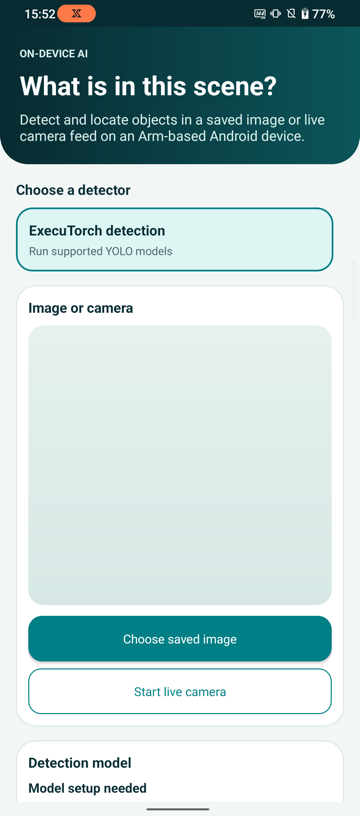 Scene Detector with ExecuTorch and LiteRT detector modes
What you’ve accomplished and what’s next
You’ve connected an Arm-based Android phone, prepared the model downloader, and confirmed that Scene Detector builds and starts.
Next, you’ll download an optimized object-detection model from the Arm AI Portal and analyze an image.