Advance robotics reinforcement learning with Isaac Lab on DGX Spark
Introduction
Manipulate objects with a Franka 7-DOF robot arm
Train contact-rich manipulation policies with Isaac Lab on DGX Spark
Train multiple agents to coordinate two Shadow Hands in one simulation
Reproduce natural motion with Adversarial Motion Priors
Choose a reinforcement learning library for your task
Next Steps
Advance robotics reinforcement learning with Isaac Lab on DGX Spark
Introduction
Manipulate objects with a Franka 7-DOF robot arm
Train contact-rich manipulation policies with Isaac Lab on DGX Spark
Train multiple agents to coordinate two Shadow Hands in one simulation
Reproduce natural motion with Adversarial Motion Priors
Choose a reinforcement learning library for your task
Next Steps
Introduce natural and humanlike motion with AMP
Adversarial Motion Priors (AMP) is a workflow that helps reinforcement learning policies produce motion that looks more natural and humanlike.
Traditional reinforcement learning can teach a robot to walk, run, or satisfy control objectives, but the resulting motion is often effective rather than natural. For robots that coexist with people, interact in human environments, or demonstrate expressive behavior, that’s usually not enough. Isaac Lab therefore supports AMP, which uses reference motion-capture data to guide policy learning toward smoother and more realistic movement.
AMP comes from the SIGGRAPH 2021 paper by researchers at UC Berkeley and collaborators: Adversarial Motion Priors for Stylized Physics-Based Character Control . At a high level, AMP works like a generative adversarial setup. A policy generates simulated motion, while a discriminator compares that motion against an unlabeled set of natural movement clips, often from motion capture. The policy then learns not only to complete the task reward, but also to produce trajectories that look statistically closer to the reference motion.
You’ll use the skrl library with the --algorithm AMP flag to run humanoid walking, running, and dancing tasks.
Train a humanoid robot to walk with a humanlike gait
You’ll use human walking reference data to train a humanoid robot to produce stable and natural walking behavior.
Run the training command
From ~/IsaacLab, launch skrl training with --algorithm AMP:
./isaaclab.sh -p scripts/reinforcement_learning/skrl/train.py \
  --task=Isaac-Humanoid-AMP-Walk-Direct-v0 \
  --headless \
  --algorithm AMP \
  --max_iterations=1000
./isaaclab.sh train \
  --rl_library skrl \
  --task=Isaac-Humanoid-AMP-Walk-Direct-v0 \
  --viz none \
  --algorithm AMP \
  --max_iterations=1000
These commands use 1,000 iterations for a short baseline. The upstream task configuration defaults to 5,000 iterations.
Verify the results of training
After training, look for the following behaviors:
- The humanoid moves forward stably instead of losing balance frequently.
- The gait shows smoother center-of-mass transfer instead of stiff hopping-like motion.
- The left and right leg timing resembles a more natural walking pattern.
./isaaclab.sh -p scripts/reinforcement_learning/skrl/play.py \
  --task=Isaac-Humanoid-AMP-Walk-Direct-v0 \
  --algorithm=AMP \
  --num_envs=16 \
  --checkpoint=logs/skrl/humanoid_amp_walk/<run_timestamp>/checkpoints/best_agent.pt \
  --real-time
./isaaclab.sh play \
  --rl_library skrl \
  --task=Isaac-Humanoid-AMP-Walk-Direct-v0 \
  --algorithm=AMP \
  --num_envs=16 \
  --checkpoint=logs/skrl/humanoid_amp_walk/<run_timestamp>/checkpoints/best_agent.pt \
  --real-time
The following is an illustrative comparison:
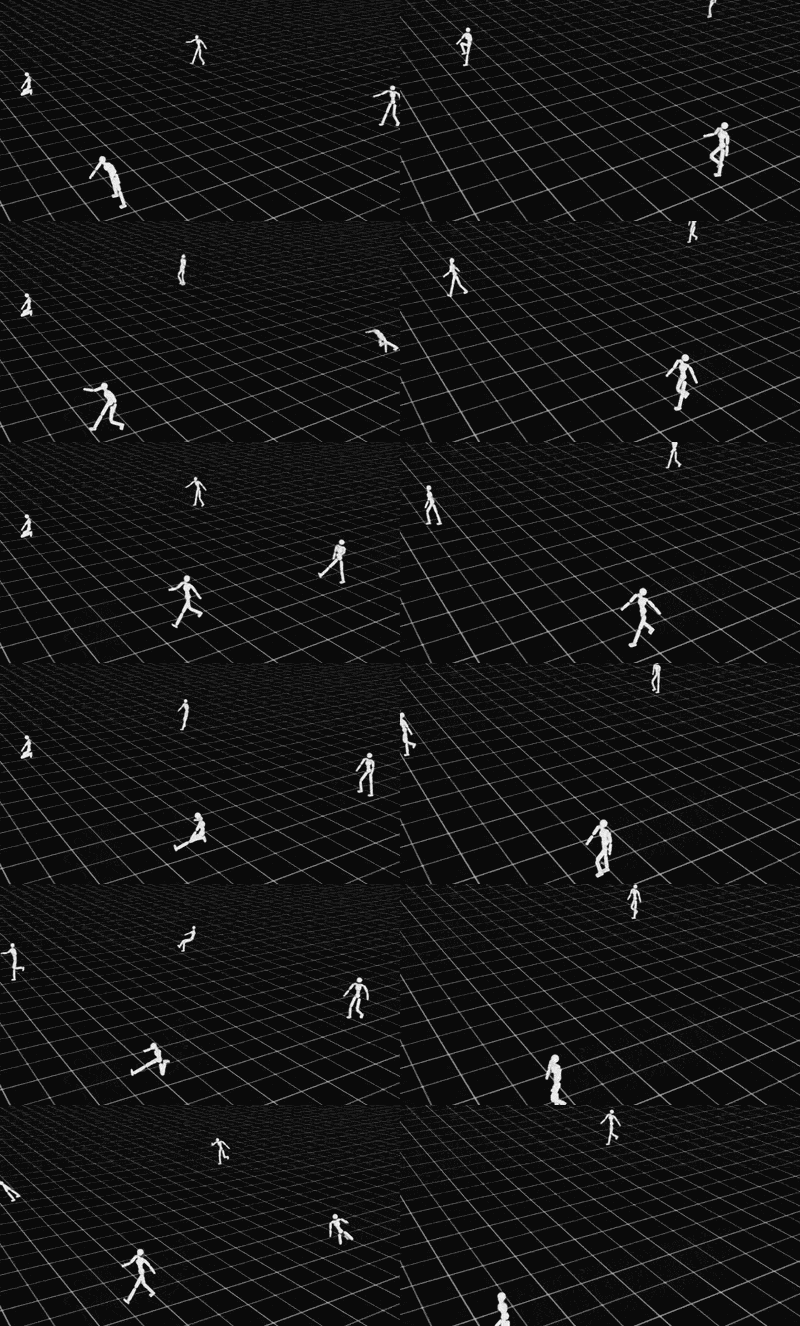 Humanoid AMP walking at 3,200 and 11,600 iterations.
Train a humanoid robot to run with speed and coordination
If walking is mainly about stability and rhythm, running introduces a higher level of dynamic coordination. The robot must generate propulsion in a shorter contact window, keep the body balanced, and avoid losing control as motion amplitude increases.
You’ll use human running reference data to train a humanoid robot to maintain a natural and controllable running pattern at higher speed.
Run the training command
From ~/IsaacLab, launch skrl training with --algorithm AMP:
./isaaclab.sh -p scripts/reinforcement_learning/skrl/train.py \
    --task=Isaac-Humanoid-AMP-Run-Direct-v0 \
    --headless \
    --algorithm AMP \
    --max_iterations=1000
./isaaclab.sh train \
    --rl_library skrl \
    --task=Isaac-Humanoid-AMP-Run-Direct-v0 \
    --viz none \
    --algorithm AMP \
    --max_iterations=1000
Verify the effects of training
After training, confirm the following:
- As forward speed increases, the robot remains stable rather than falling immediately.
- Arm swing, leg lift, and landing timing become more coordinated.
- The motion looks like a recognizable running pattern rather than uncontrolled forward movement.
./isaaclab.sh -p scripts/reinforcement_learning/skrl/play.py \
  --task=Isaac-Humanoid-AMP-Run-Direct-v0 \
  --algorithm=AMP \
  --num_envs=16 \
  --checkpoint=logs/skrl/humanoid_amp_run/<run_timestamp>/checkpoints/best_agent.pt \
  --real-time
./isaaclab.sh play \
  --rl_library skrl \
  --task=Isaac-Humanoid-AMP-Run-Direct-v0 \
  --algorithm=AMP \
  --num_envs=16 \
  --checkpoint=logs/skrl/humanoid_amp_run/<run_timestamp>/checkpoints/best_agent.pt \
  --real-time
The following is an illustrative comparison:
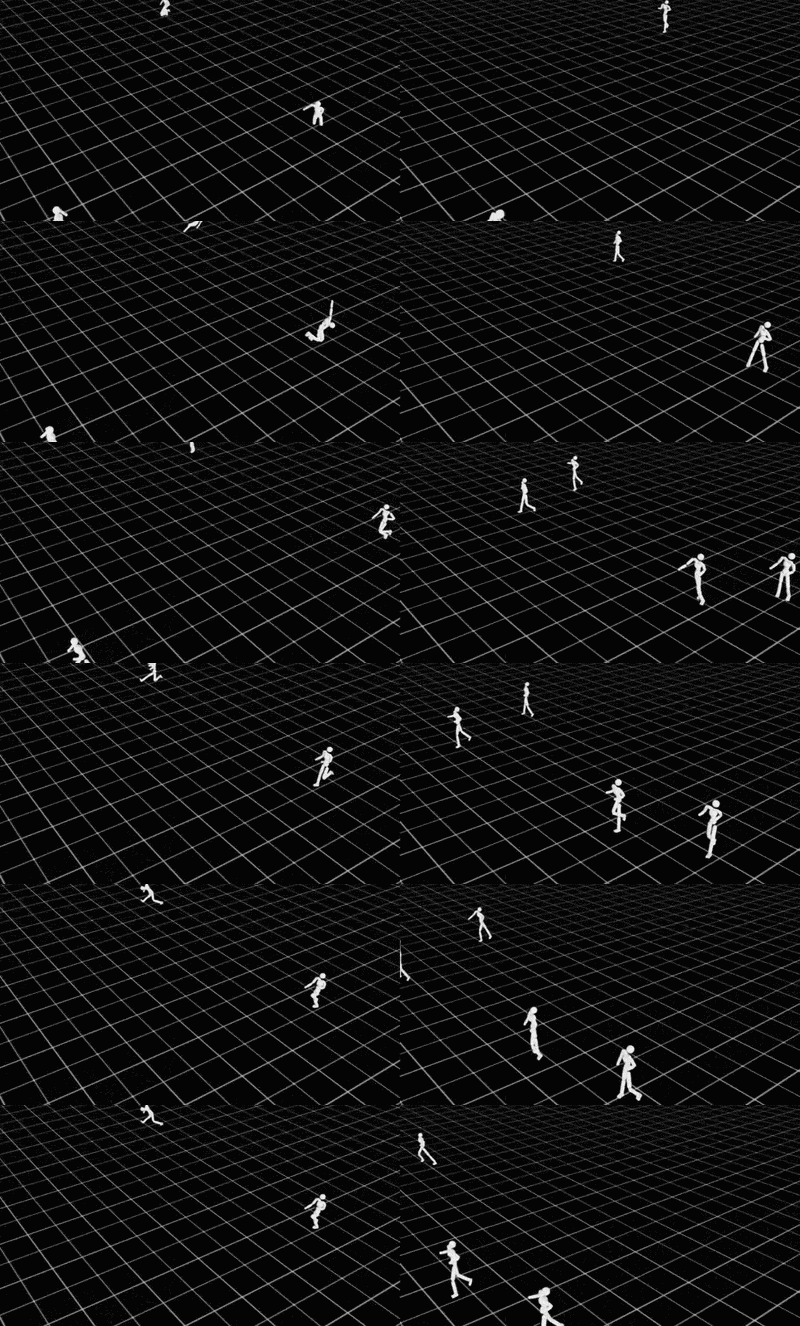 Humanoid AMP running at 3,000 and 26,000 iterations
To continue training from a checkpoint, run:
./isaaclab.sh -p scripts/reinforcement_learning/skrl/train.py \
    --task=Isaac-Humanoid-AMP-Run-Direct-v0 \
    --headless \
    --algorithm AMP \
    --max_iterations=<number of additional iterations (Epochs)> \
    --checkpoint=<path_to_checkpoint>
./isaaclab.sh train \
    --rl_library skrl \
    --task=Isaac-Humanoid-AMP-Run-Direct-v0 \
    --viz none \
    --algorithm AMP \
    --max_iterations=<number of additional iterations (Epochs)> \
    --checkpoint=<path_to_checkpoint>
Try training the model further to see if the skipping-like motion evolves into a run.
(Optional) Train a humanoid robot to dance
To optionally test style-heavy motion generation, run the following AMP dance task:
./isaaclab.sh -p scripts/reinforcement_learning/skrl/train.py \
    --task=Isaac-Humanoid-AMP-Dance-Direct-v0 \
    --headless \
    --algorithm AMP
./isaaclab.sh train \
    --rl_library skrl \
    --task=Isaac-Humanoid-AMP-Dance-Direct-v0 \
    --viz none \
    --algorithm AMP
As of May 2026, training this model with the default number of iterations typically takes several hours on a DGX Spark. A pre-trained checkpoint for the dance task isn’t available at this time, so you’ll need to train the model from scratch.
What you’ve accomplished and what’s next
You’ve now used AMP to compare task completion with motion quality across humanoid behaviors.
Next, you’ll compare the main reinforcement learning libraries supported by Isaac Lab.