Deploy firmware on hybrid edge systems using containers
Introduction
Motivation
Hybrid container runtime
AVH device setup
Deploy firmware container using `containerd`
Deploy SMARTER Demo using K3s
Building the hybrid-runtime and container image (optional)
Next Steps
Deploy firmware on hybrid edge systems using containers
Overview
The hybrid-runtime is a low-level Open Container Initiative (OCI) compatible runtime. It’s written in Rust.
There are three components that make up the runtime (shown as green in the figure below):
- The Command Line interface (CLI), which follows the OCI specification requirements. The runtime provides an executable that supports an array of commands, using the following template:
$ runtime [global-options] <COMMAND> [command-specific-options] <command-specific-arguments>
The list of commands are as per the v1.2
specification
: create, start, run, delete, kill, state, logs
- The hybrid-runtime provides the core functionality of each of the previously mentioned commands.
- The hybrid-shim is a lightweight component that sits between the
hybrid-runtimeandcontainerd. It helps facilitate communication between both, handling tasks such as the container process management and keeping track of the status of the container.
You can review the runtime high-level architecture in the image below:
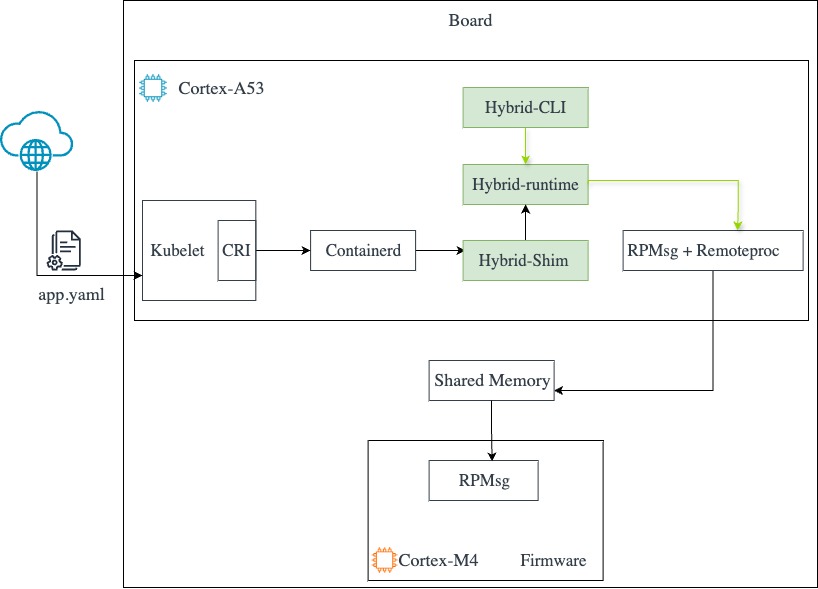 Hybrid-runtime architecture diagram
Now that you have an understanding of the hybrid-runtime, let’s move on to the deployment part.