Build and deploy multi-node Zenoh systems on Raspberry Pi
Introduction
Build scalable communication systems with Eclipse Zenoh
Get started with Zenoh on Raspberry Pi and Arm Linux
Containerize and deploy Zenoh across multiple Raspberry Pi devices
Run a simple Zenoh pub/sub example
Run a Zenoh storage and query example
Run a Zenoh queryable node for on-demand edge computation
Run a Zenoh queryable with parameterized Rust computation
Next Steps
Build and deploy multi-node Zenoh systems on Raspberry Pi
Introduction
Build scalable communication systems with Eclipse Zenoh
Get started with Zenoh on Raspberry Pi and Arm Linux
Containerize and deploy Zenoh across multiple Raspberry Pi devices
Run a simple Zenoh pub/sub example
Run a Zenoh storage and query example
Run a Zenoh queryable node for on-demand edge computation
Run a Zenoh queryable with parameterized Rust computation
Next Steps
Parameterized battery health estimation with Zenoh queryable
Finally, you’ll combine pub/sub, storage, and queryable components to simulate a distributed computation flow - demonstrating how Zenoh enables intelligent, coordinated edge systems.
You’ll learn how to use Zenoh’s Queryable API in Rust to build a parameterized query system for estimating battery health at the edge.
This extends a previous example by supporting runtime query parameters like battery level and temperature.
Use case: real-time battery health through on-demand computation
In robotic fleet management, a central controller may need to assess each robot’s battery health on demand.
Instead of streaming data continuously, robots expose a queryable endpoint that returns a real-time health score based on current battery level and temperature.
This saves bandwidth and enables lightweight edge-side decision-making.
Create a new Zenoh rust project
On any Raspberry Pi:
cd ~/zenoh
cargo new zenoh_battery_estimator
Update following dependencies setting by editing the file $HOME/zenoh/zenoh_battery_estimator/Cargo.toml
[dependencies]
zenoh = { path = "../zenoh" }
tokio = { version = "1", features = ["full"] }
url = "2"
Implement the queryable node
Next, log in to the other Raspberry Pi.
Replace the contents of $HOME/zenoh/zenoh_battery_estimator/src/main.rs with the code below.
use zenoh::{open, Config};
use std::collections::HashMap;
use url::form_urlencoded;

#[tokio::main]
async fn main() -> zenoh::Result<()> {
    let session = open(Config::default()).await?;

    let _queryable = session
        .declare_queryable("robot/battery/estimate")
        .callback(|query| {
            tokio::spawn(async move {
                let selector = query.selector();
                let key = selector.key_expr();

                let params = selector.parameters().as_str();

                let decoded: HashMap<_, _> =
                    form_urlencoded::parse(params.as_bytes()).into_owned().collect();

                let battery = decoded
                    .get("level")
                    .unwrap_or(&"50".to_string())
                    .parse::<u32>()
                    .unwrap_or(50);

                let temp = decoded
                    .get("temp")
                    .unwrap_or(&"25".to_string())
                    .parse::<u32>()
                    .unwrap_or(25);

                let health_score = 100 - (100 - battery) - ((temp.saturating_sub(25)) / 2);
                let response = format!("Estimated battery health: {}%", health_score);

                let _ = query.reply(key, response).await;
            });
        })
        .await?;

    println!("Queryable running on 'robot/battery/estimate'");
    tokio::signal::ctrl_c().await.unwrap();
    Ok(())
}
This edge node responds to real-time queries using Zenoh’s Queryable API. It listens for requests on the robot/battery/estimate key and returns a calculated battery health score based on provided input parameters.
The program starts by establishing a Zenoh session using open(Config::default()). It then registers a queryable resource on the robot/battery/estimate key. Whenever this key is queried, a callback function is invoked asynchronously using tokio::spawn.
Inside the callback:
- Query parameters are extracted from the URL-style selector string.
- Two main parameters are used: level (battery percentage) and temp (temperature in Celsius).
- A health score is computed from these inputs.
- The result is sent back to the querying client using query.reply().
You can extend this queryable pattern to respond to other real-time diagnostics, such as CPU load, camera snapshots, or local ML inference results.
This design pattern enables efficient, on-demand data exchange with minimal bandwidth usage. This is ideal for edge computing scenarios where resources and connectivity are constrained.
Battery health estimation formula
The health score is calculated using the following logic:
let health_score = 100 - (100 - battery) - ((temp.saturating_sub(25)) / 2);
This formula estimates battery health as a percentage, considering both battery level and temperature:
- battery: Current battery level (default 50%)
- temp: Current temperature (default 25°C)
This logic computes battery health as a percentage, adjusting for elevated temperatures. If temperature exceeds 25°C, the score is reduced by 1% for every 2°C increase.
To ensure the calculation remains safe even when the temperature is below 25°C, the code uses saturating_sub(25), which prevents the result from becoming negative and avoids potential underflow errors.
For example, if battery = 88 and temp = 32, then:
- Temperature offset = (32 - 25) / 2 = 3
- Health = 88 - 3 = 85%
Build and run
cd $HOME/zenoh/zenoh_battery_estimator
cargo build --release
After the build process, you will see:
           Compiling zenoh_battery_estimator v1.4.0 (/home/ubuntu/zenoh_v1.4/zenoh_battery_estimator)
    Finished `release` profile [optimized] target(s) in 1m 22s
Query it with parameters
Run it on the Raspberry Pi you used for the build run:
cd $HOME/zenoh/target/release/
./zenoh_battery_estimator
You can reuse the built-in Zenoh z_get CLI from the other Raspberry Pi.
cd ~/zenoh/target/release/examples
./z_get -s "robot/battery/estimate?level=88&temp=32"
The result is shown below:
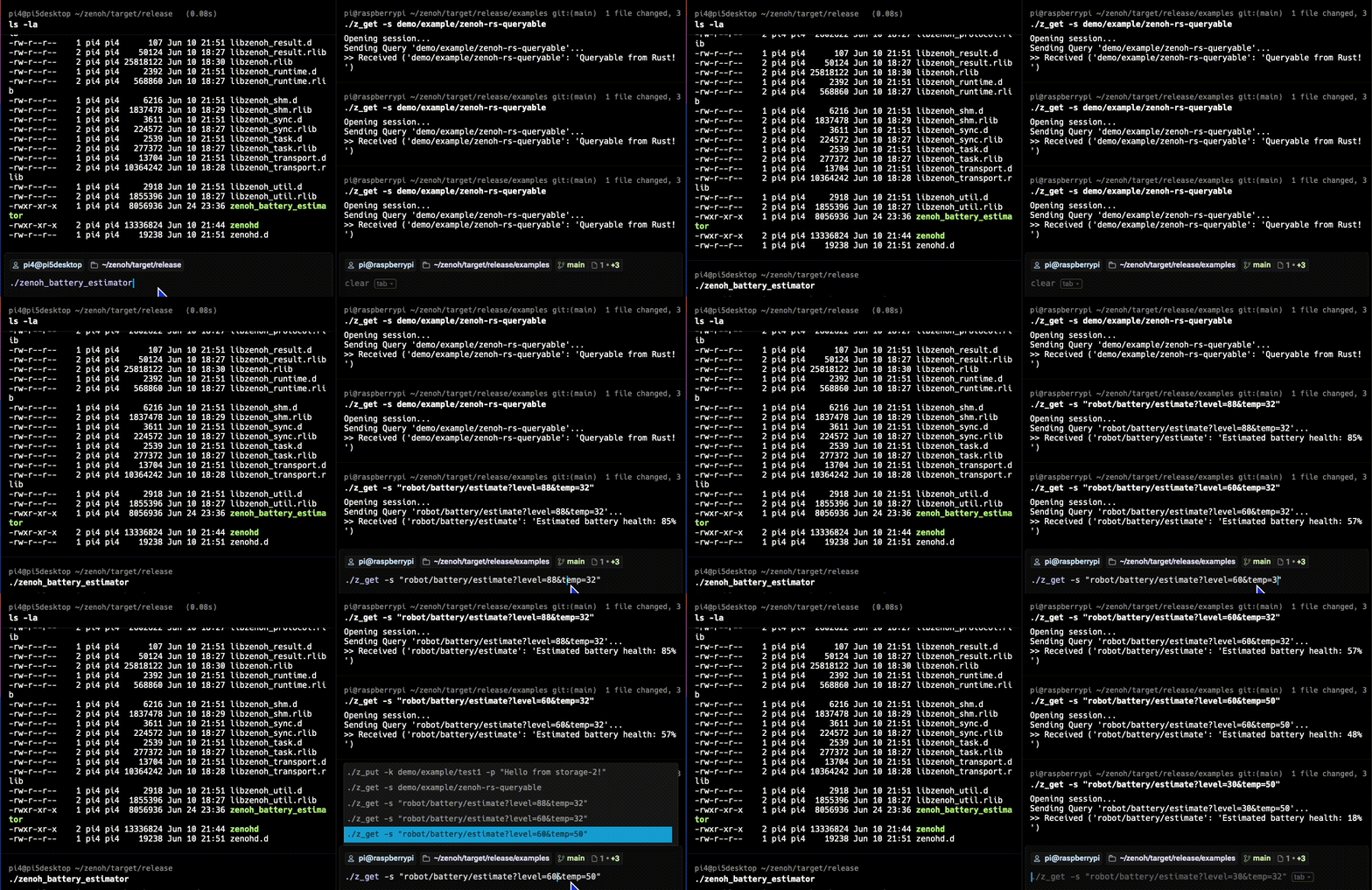 Figure 4: Dynamic Queryable with Computation
The expected output is:
>> Received ('robot/battery/estimate': 'Estimated battery health: 85%')
You’ve just built a responsive, parameterized edge compute service using Zenoh’s Queryable API in Rust. It’s lightweight but a powerful pattern for real-time intelligence at the edge.
This approach not only minimizes network overhead but also enables each device to process and respond to context-aware queries on demand.
It’s a strong foundation for building scalable, event-driven IoT systems that can adapt dynamically to operational needs.