Export and quantize SmolVLA for ONNX Runtime on Arm
Introduction
Set up the SmolVLA environment
Export and validate the SmolVLA ONNX model
Quantize SmolVLA to INT4 and compare it with FP32
Next Steps
Export and quantize SmolVLA for ONNX Runtime on Arm
Scope of INT4 quantization
TorchAO quantizes eligible constant linear weights across the exported SmolVLA
model. The converter replaces supported ONNX MatMul and Gemm operations
with packed com.microsoft::MatMulNBits operations.
This is weight-only quantization, not an entirely INT4 graph.
On supported Arm CPUs, ONNX Runtime can use optimized kernels such as KleidiAI.
With the quantization scope established, convert the eligible linear weights to a packed INT4 ONNX model.
Create the packed INT4 model
Run the TorchAO converter:
python scripts/quantize_onnx_torchao.py \
  --input work/onnx/fp32/model.onnx \
  --output work/onnx/int4/smolvla-int4.onnx
The quantization processes each eligible weight individually and might take several minutes on an embedded system.
The command creates a packed ONNX file and reports how many eligible linear operations were converted. Dynamic or unsupported matrix multiplications remain in floating point.
Compare FP32 and INT4
Run both models with the deterministic reference batch created during export:
python scripts/compare_onnx_outputs.py \
  --fp32-model work/onnx/fp32/model.onnx \
  --int4-model work/onnx/int4/smolvla-int4.onnx \
  --reference-dir work/onnx/fp32/reference \
  --output work/comparison/smolvla-action-comparison.png
The script runs both models with ONNX Runtime CPUExecutionProvider and
creates work/comparison/smolvla-action-comparison.png and work/comparison/smolvla-action-comparison.json.
Interpret the FP32 and INT4 comparison
The figure compares all seven normalized output channels and median latency. The JSON file records the latency and overall output error.
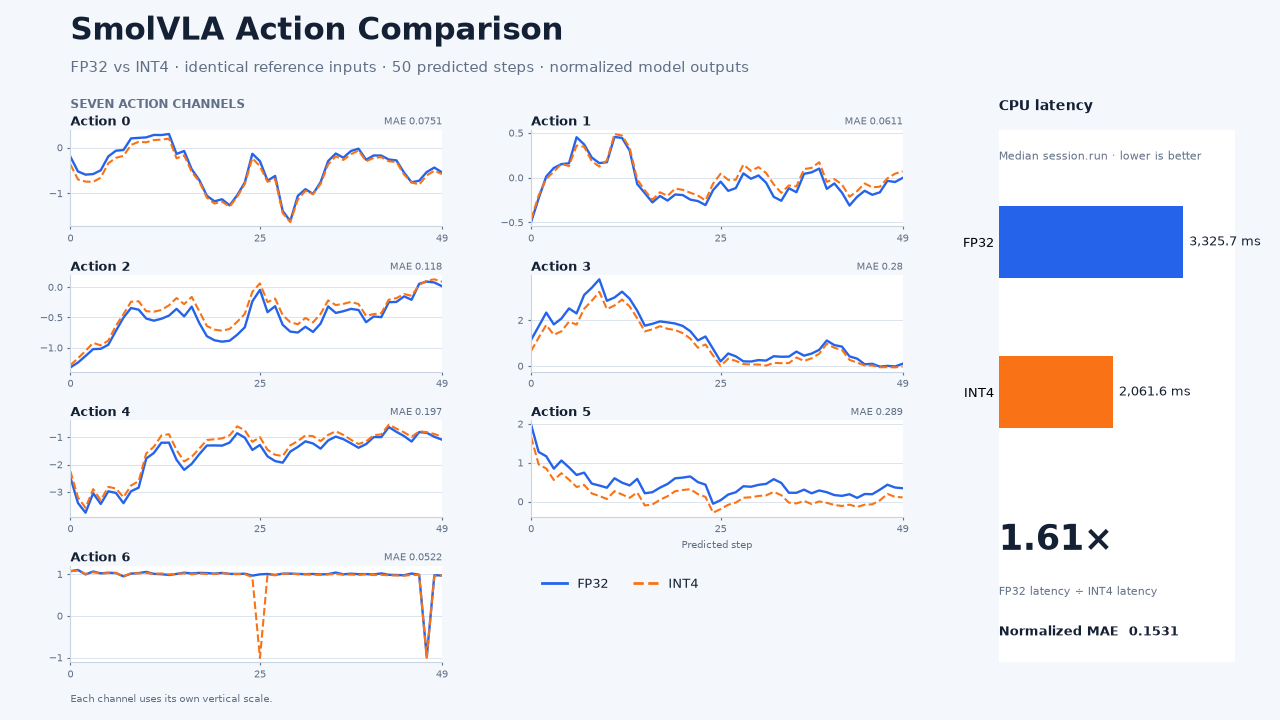 SmolVLA action comparison
On the Radxa Orion O6, INT4 reduced median ONNX Runtime latency from 3.33 seconds to 2.06 seconds, a 1.61x speedup. The normalized outputs had an MAE of 0.153.
Your results will vary depending on the Arm system, core count, and memory bandwidth available.
What you’ve accomplished
You’ve converted eligible SmolVLA linear weights to packed INT4 in an ONNX model, run FP32 and INT4 with identical inputs on an Arm CPU, and compared all seven normalized output channels and ONNX Runtime latency.
From here, you can integrate the ONNX model into a robotics pipeline, experiment with different quantization group sizes, or benchmark on other Arm platforms.