Run and benchmark BitNet-2B inference on Arm CPUs with Litespark-Inference
Introduction
Understand Litespark-Inference and BitNet b1.58
Run BitNet-2B with Litespark-Inference
Benchmark Litespark-Inference on Arm
Next Steps
Run and benchmark BitNet-2B inference on Arm CPUs with Litespark-Inference
What Litespark-Inference is
Litespark-Inference is an open-source runtime designed to execute ternary-weight language models, such as
BitNet b1.58
, directly on host CPUs. It performs inference without using a GPU or PyTorch at runtime. The PyTorch and Transformers packages are declared as dependencies for benchmarking and model-loading utilities, but the torchless inference path relies only on numpy, safetensors, and tokenizers.
Litespark-Inference runs on the following platforms:
| Platform | Kernel selected automatically |
|---|---|
| Linux on Arm Neoverse | NEON + SDOT |
| macOS on Apple Silicon | NEON + SDOT |
| Linux on x86_64 with AVX-512 | AVX-512 + VNNI |
| Linux on x86_64 with Intel Core Ultra | AVX-VNNI (256-bit) |
| Linux on x86_64 (no VNNI) | AVX2 + FMA fallback |
During pip install, the build process automatically detects your CPU’s hardware feature flags and compiles the appropriate C++ kernel for your machine.
How BitNet b1.58 accelerates CPU inference
BitNet b1.58 stores each weight as a value in {-1, 0, +1} and packs
four weights into one byte. This provides two key benefits:
- Reduced memory footprint: The model file is around 6x smaller than the equivalent BF16 model (around 497 MB packed versus around 4,600 MB unpacked).
- SIMD compute efficiency: Every matrix multiplication reduces to INT8 activation × ternary weight, taking direct advantage of CPU SIMD dot-product instructions, such as
SDOTon Arm Neon andVNNIon x86.
The net effect is that a 2-billion-parameter model fits in under 1 GB of RAM and generates tokens at interactive speed on a laptop or cloud CPU instance.
The following charts show Litespark-Inference against a PyTorch baseline across several Arm and x86 CPUs. Token-generation throughput is roughly an order of magnitude higher, and resident memory is around 6x smaller, on every platform tested.
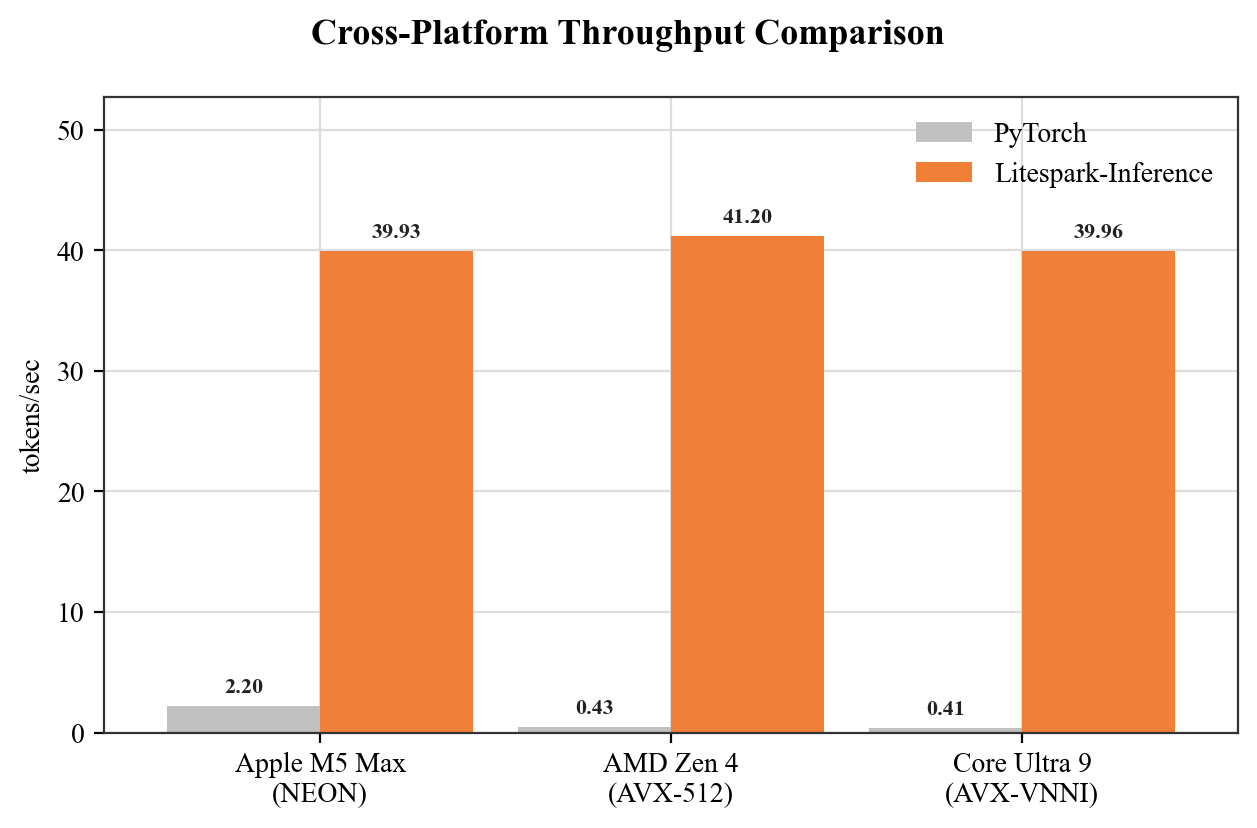 Cross-platform throughput comparison
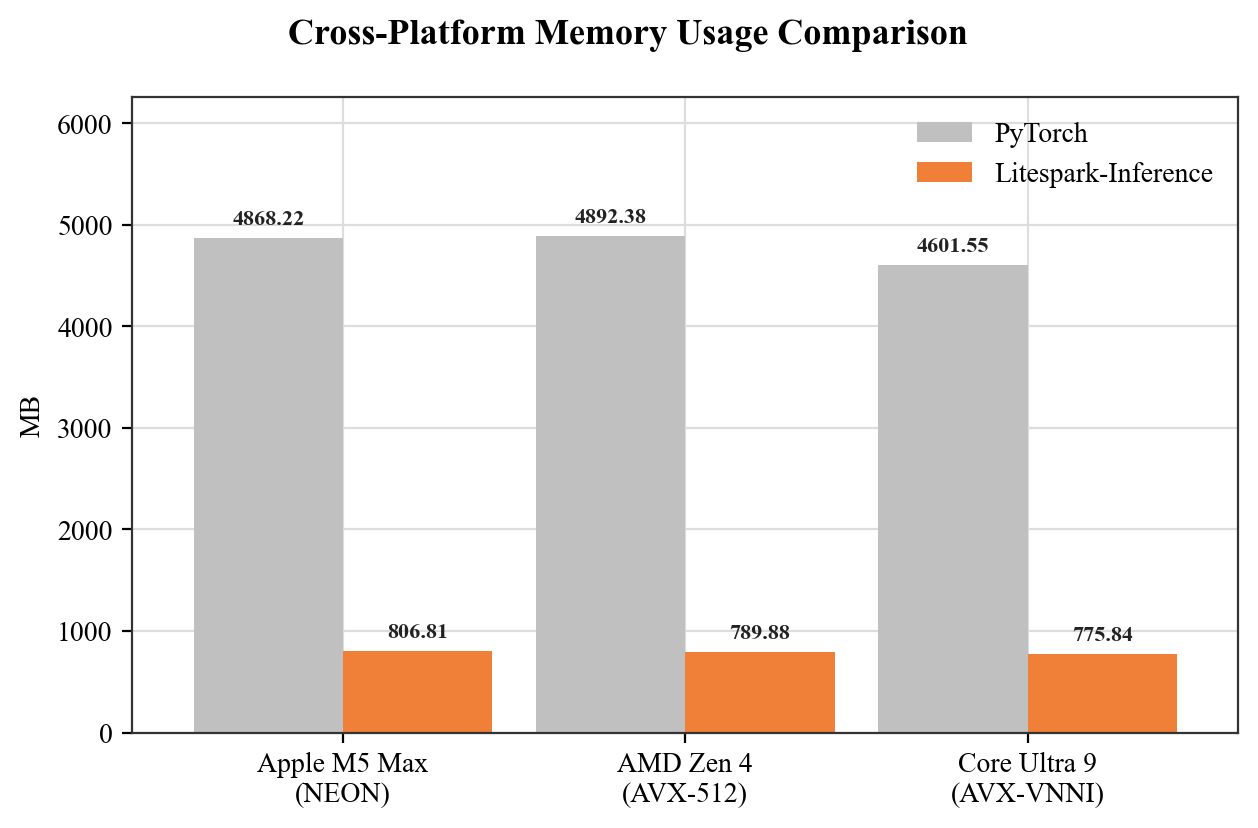 Cross-platform memory usage comparison
What you’ve learned and what’s next
You’ve now learned how Litespark-Inference enables CPU inference without GPU or PyTorch runtime dependencies. You’ve also learned how ternary quantization (BitNet b1.58) compresses resident memory footprint and uses Arm Neon SDOT SIMD instructions.
Next, you’ll learn how to run BitNet-2B from the CLI and using Python.