# Visual Studio for Windows on Arm
## About this Install Guide
| | |
| --- | --- |
| Reading time: | 30 min |
| Last updated: | 22 Jun 2026 |
| Ecosystem dashboard: | [View](https://developer.arm.com/ecosystem-dashboard/windows?package=Visual%20Studio) |
| | |
| --- | --- |
| Author: | Pareena Verma , Arm
[GitHub](https://github.com/pareenaverma)
[LinkedIn](https://linkedin.com/in/pareena-verma-7853607) |
| Official docs: | [View](https://learn.microsoft.com/en-us/visualstudio/install/visual-studio-on-arm-devices) |
This guide shows you how to install and use the tool with the most common configuration. For advanced options and complete reference information, see the official documentation. Some install guides also include optional next steps to help you explore related workflows or integrations.
Visual Studio 2022 version 17.4 and higher natively supports Windows on Arm devices, enabling you to develop C and C++ applications directly on Arm hardware using the MSVC or LLVM toolchains.
## How do I download and install Visual Studio for Windows on Arm?
[Download the Visual Studio Installer](https://visualstudio.microsoft.com/vs/) to get started.
> **Note**
> There are 3 different versions available to download: Community, Professional and Enterprise. Choose the appropriate version for your usage.
Once downloaded, run the `VisualStudioSetup.exe` file on a Windows on Arm machine. This is the installer.
## How do I install C and C++ support in Visual Studio?
During the installation process, you will be asked to choose the workloads you want and customize your installation. At a minimum, select `Desktop development with C++`.
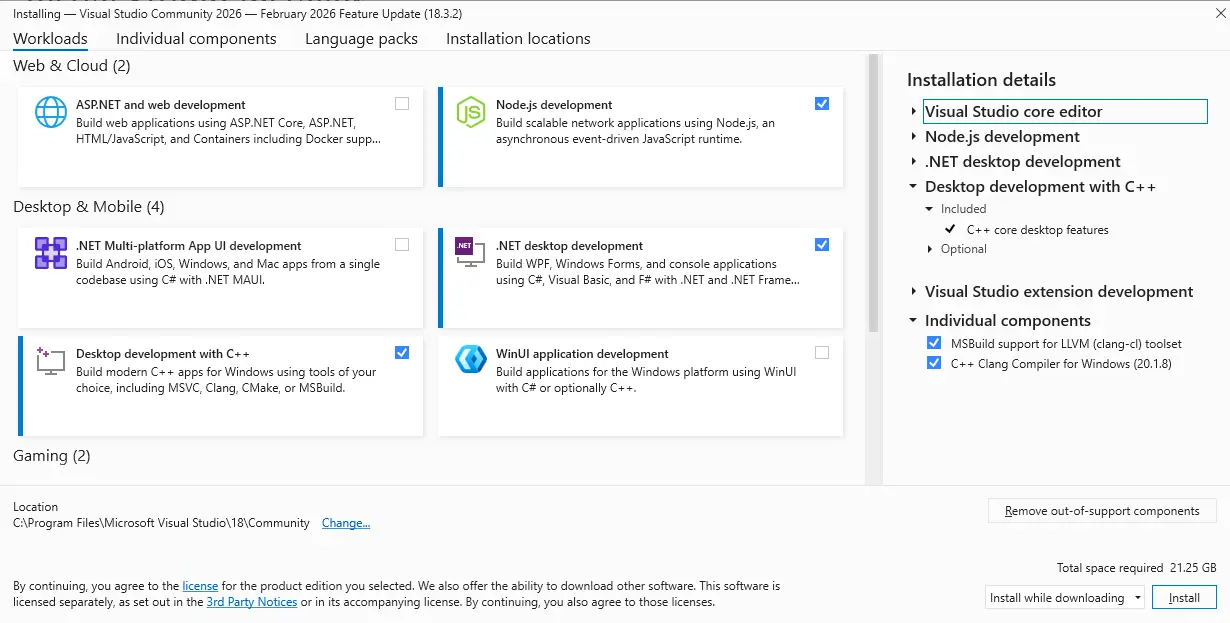
## How do I install LLVM support in Visual Studio?
To build native Windows Applications using the LLVM toolchain in Visual Studio, you need to install additional components.
In the installer, select the `Individual components` tab. Enter `clang` in the search bar.
Two results are displayed: The LLVM compiler and MSBuild support for LLVM. Select both these options:
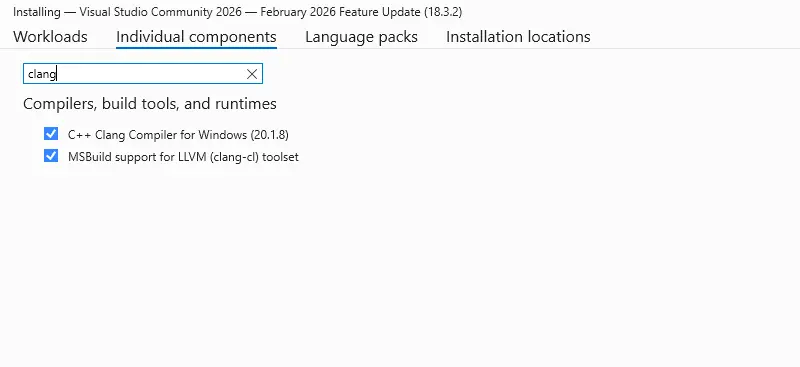
> **Note**
> Different versions of Visual Studio include different LLVM toolchain versions. For example, Visual Studio 2026 Version `18.3.2` installs `LLVM 19.1.2`.
LLVM supports `clang-cl`, a compatibility layer for Microsoft Visual C++ (MSVC). This means that most developers can use `clang-cl` to compile their C/C++ applications on Visual Studio/MSBuild on the Windows on Arm device, without needing to change the command line. This allows you to easily modify legacy projects that use MSVC to use native compilation.
You can now proceed with `Install`. The installation process can take several minutes to complete. A reboot of your machine is required before you launch Visual Studio.
## How do I modify my Visual Studio installation?
The workload and individual component selection can also be made at any time after you complete the installation of Visual Studio. To modify your installation, run `VisualStudioSetup.exe`, select `Continue` to accept the installation conditions and then choose `Modify`.
You can choose additional workloads and individual components to further customize your installation.
For the latest updates on Arm native development, check the [Windows on Arm](https://learn.microsoft.com/en-us/windows/arm/overview) documentation.