View the GPT-2 benchmark results
At this point, the results directory should contain three GPT-2 result files:
gpt2_pytorch.jsongpt2_portable.jsongpt2_xnnpack.json
Use this Python script to display results in a browser dashboard. Serve the result dashboard from the Raspberry Pi:
course_support/serve_results.py \
  --results ~/executorch_on_arm/module-1-transformer-inference-with-xnnpack/results \
  --host 127.0.0.1 \
  --port 8080
Then open the dashboard locally on your development machine:
http://localhost:8080
The dashboard should contain the three GPT-2 results generated so far.
The reference results below show the expected pattern, although your timings will likely differ:
| Runtime | Warmups | Runs | Mean | Median | Min | Max |
|---|---|---|---|---|---|---|
| PyTorch eager | 2 | 20 | 604.44 ms | 603.07 ms | 600.13 ms | 614.17 ms |
| ExecuTorch with portable kernels | 1 | 1 | 63,435.01 ms | 63,435.01 ms | 63,435.01 ms | 63,435.01 ms |
| ExecuTorch with XNNPACK | 2 | 20 | 383.09 ms | 370.46 ms | 368.12 ms | 429.26 ms |
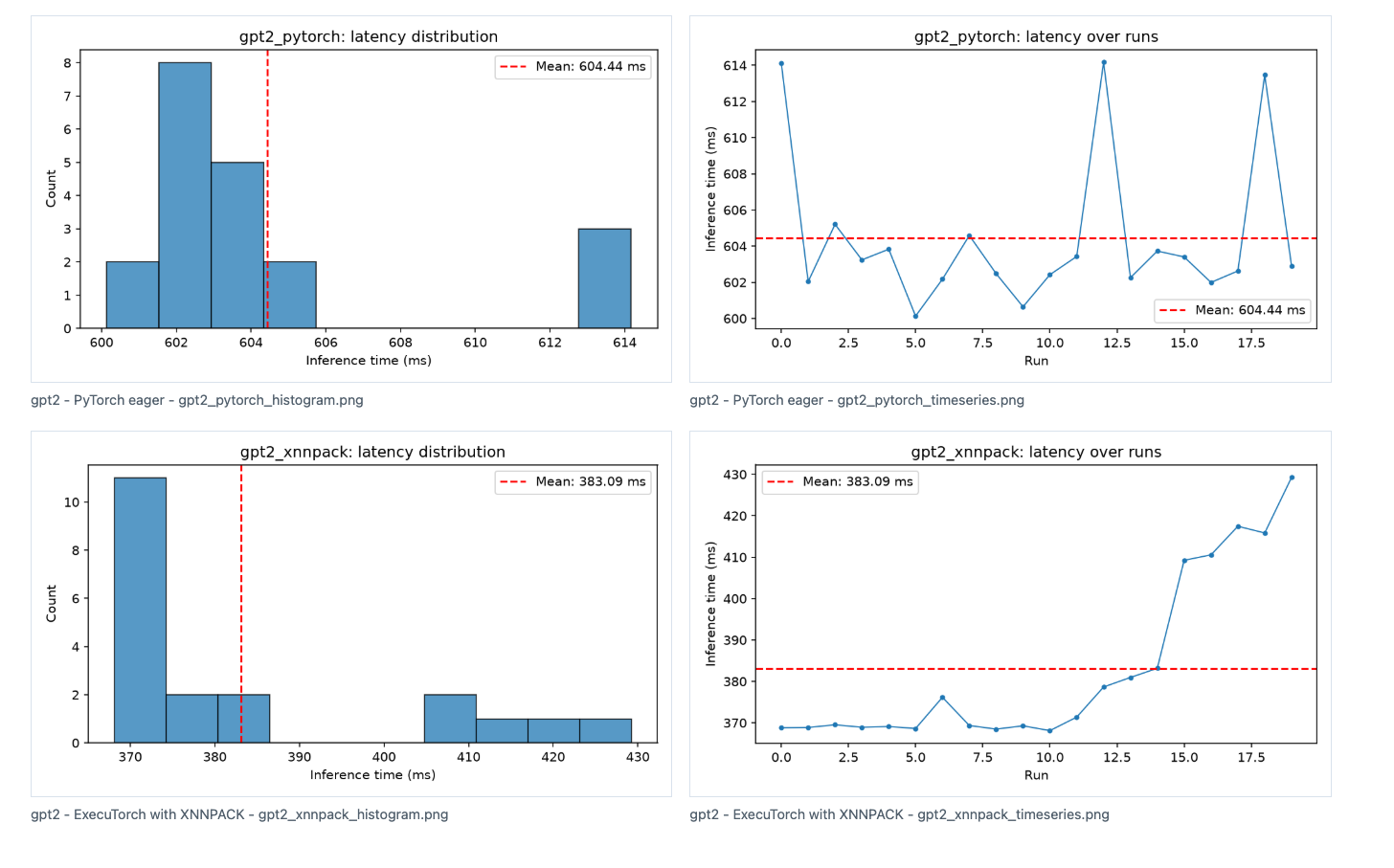
In the reference run, XNNPACK reduced mean latency from 604.44 ms to 383.09 ms compared with PyTorch eager execution. This is approximately a 1.6× speedup, or a 37% reduction in mean latency. The median values show a similar result: 603.07 ms for PyTorch eager and 370.46 ms for XNNPACK. The single run of the portable kernel artifact took around 63.4 seconds. It should be immediately clear that while the portable kernels provided functional execution on-device, they did so without performance optimizations.
Despite not all operators being delegated and delegation being fragmented, the XNNPACK path achieved lower latency than PyTorch eager, and significantly lower latency than the portable kernel artifact. This indicates that the delegated regions included computationally significant transformer operations, optimizing bottleneck areas.
The XNNPACK .pte artifact was 154.45 MB, or approximately 31%, larger than
the portable artifact. Whether this increase is acceptable depends on the
target’s storage and packaging constraints.
Course complete
Nice work
You completed Optimize and deploy AI inference with ExecuTorch on Arm.